

Key Takeaways
Option A
The 50/30/20 Rule
The flexible, percentage-based framework for modern budgeters.
Best for: People who want a simple, low-maintenance structure that guides spending without tracking every dollar.
Option B
Envelope Budgeting
The hands-on, category-by-category cash control system.
Best for: People who overspend in specific categories and want firm, physical limits on their discretionary cash.
If you want a simple, low-effort budgeting structure
The 50/30/20 Rule
The percentage-based approach requires no granular tracking and adapts easily to income changes, making it sustainable for busy or budget-averse individuals.
If you consistently overspend in specific categories like dining or shopping
Envelope Budgeting
Hard category limits create a natural spending brake. When the envelope is empty, spending stops - no willpower required.
If you have irregular or variable income
Envelope Budgeting
Allocating real dollars (or digital equivalents) to categories on a per-paycheck basis keeps spending tied to what you actually received, not a percentage estimate.
If you're building long-term savings habits for the first time
The 50/30/20 Rule
Designating 20% explicitly for savings and debt repayment makes the saving habit structural rather than an afterthought.
If you're managing a household budget with a partner
The 50/30/20 Rule
Broad categories reduce friction between partners with different spending values, leaving room for individual discretion within agreed-upon limits.
How Each Framework Actually Works
Before comparing the two methods head-to-head, it helps to understand the mechanical logic behind each one.
The 50/30/20 rule - popularized in personal finance circles over the past two decades - divides your monthly after-tax income into three buckets: 50% toward needs (rent, groceries, utilities, insurance), 30% toward wants (dining out, entertainment, subscriptions), and 20% toward savings and debt repayment beyond minimum payments. The percentages are targets, not ceilings. The system doesn't prescribe what goes inside each bucket beyond those broad labels.
For a deeper look at how 50/30/20 compares to another structured approach, see zero-based budgeting vs. the 50/30/20 rule.
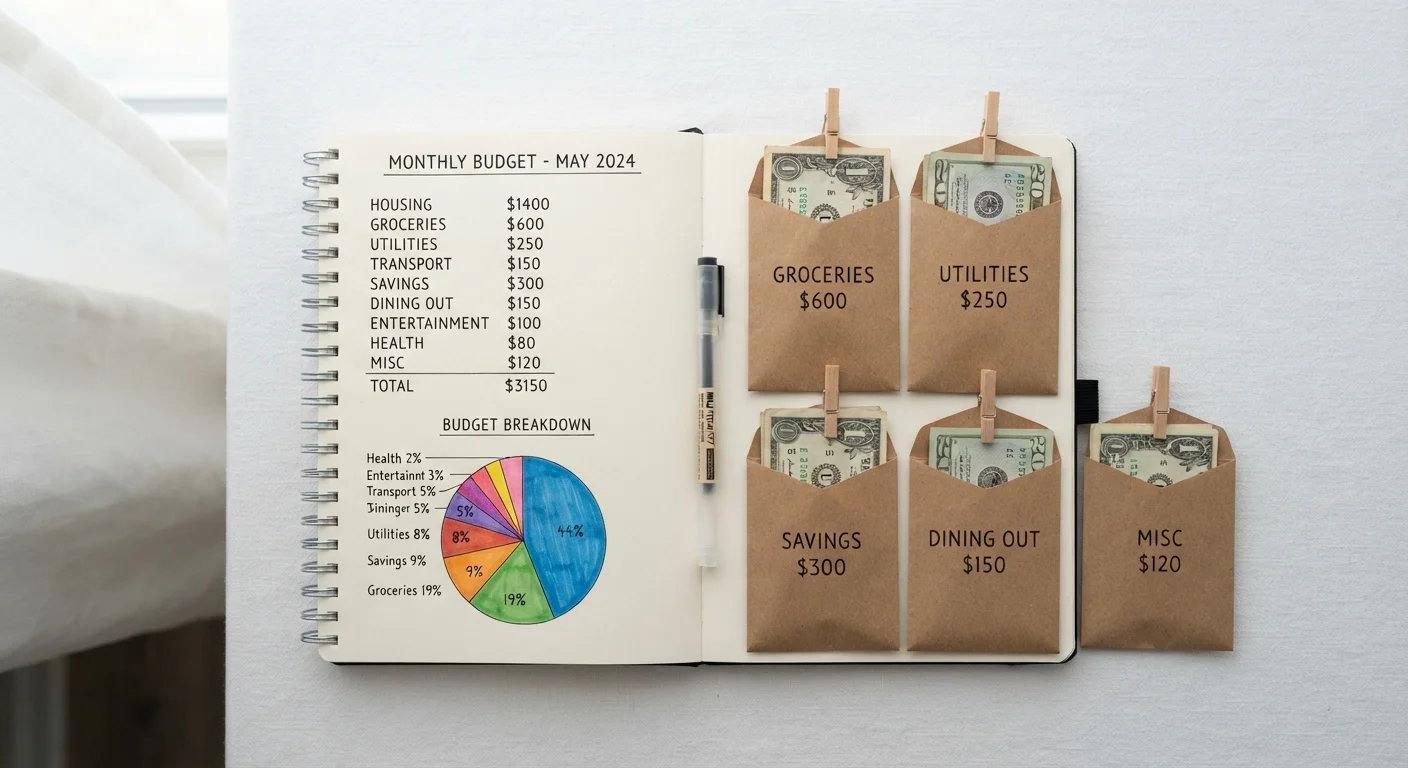
Envelope budgeting is older and more granular. At the start of each pay period, you divide your income into labeled envelopes - groceries, gas, dining, entertainment, clothing - and place the designated cash amount in each one. Once an envelope is empty, spending in that category stops until the next funding cycle. Many people now use digital envelope systems (apps or spreadsheet tabs) that replicate this logic without physical cash.
Both systems share the same fundamental goal: give every dollar a purpose before it gets spent. They just approach that goal with very different levels of detail and constraint.
| Criterion | 50/30/20 Rule | Envelope Budgeting |
|---|---|---|
| Granularity | Three broad buckets | Detailed per-category limits |
| Setup time | Minimal - one-time calculation | Higher - allocate each pay period |
| Ongoing maintenance | Low - monthly review | High - track and refill regularly |
| Flexibility for surprises | High - buckets absorb variance | Lower - requires reallocation |
| Spending control precision | Moderate | High - hard category stops |
| Best for income type | Stable, predictable income | Variable or irregular income |
| Digital-friendly | Yes - easy to track in apps | Yes - digital envelope apps available |
| Learning curve | Very low | Moderate |
Where Each System Succeeds - and Struggles
The 50/30/20 rule's greatest strength is its low overhead. You don't need to categorize every transaction or hunt for receipts. Review your bank statement at month's end, confirm spending roughly aligns with the three buckets, and adjust as needed. This makes it accessible for people who are new to budgeting or who find detailed tracking unsustainable. It also handles income variation gracefully - a larger paycheck simply means proportionally more in each bucket.
The trade-off is vagueness. A household spending 49% on needs and 31% on wants is technically within the framework, but might not notice that restaurant bills have quietly crowded out grocery shopping. The broad buckets can mask problematic patterns within categories.
Envelope budgeting excels precisely where the 50/30/20 rule is weakest. By isolating each spending category, it makes overspending visible and immediate. Research in behavioral economics consistently shows that paying with physical cash reduces spending compared to card transactions - a phenomenon sometimes called the "pain of paying." Even digital envelope systems retain some of this friction by forcing category-level decisions before the money is spent.
The challenge is upkeep. Envelope budgeting requires more setup time, more ongoing maintenance, and more cognitive engagement. For variable or irregular income, calculating envelope amounts at the start of each period takes real effort. And when life happens - an unexpected car repair, a medical bill - reallocating across envelopes requires deliberate decision-making rather than the flexible absorption that the 50/30/20 rule allows.
Digital Envelope Apps: A Middle Ground
Several budgeting apps replicate envelope logic without requiring physical cash. These tools let you assign income to virtual categories, track spending in real time, and receive alerts when a category runs low. They capture much of the behavioral friction of physical envelopes while accommodating the card-based spending that most Americans rely on day-to-day. If going fully cash-based feels impractical, a digital envelope system is a reasonable alternative worth exploring.
For a frank accounting of what detailed budgeting demands in time and flexibility, The Honest Trade-Offs of Living on a Strict Budget lays out both sides clearly.
Choosing the Right Fit - or Combining Both
The most practical question isn't which system is objectively better - it's which one you'll actually maintain. A budgeting method you abandon after three weeks delivers zero benefit.
~74%
Americans living paycheck to paycheck
Surveys conducted by various financial research organizations consistently find that a significant majority of U.S. adults have little to no financial cushion at month's end, underscoring why a structured budgeting method matters.
12-18%
Spending reduction with cash vs. cards
Behavioral economics research, including work associated with the MIT Sloan School of Management, has found that consumers tend to spend meaningfully less when using physical cash compared to credit or debit cards.
Consider starting with the 50/30/20 rule if you've never budgeted before, if your finances are relatively straightforward, or if you're primarily trying to build a savings habit. Its simplicity lowers the barrier to entry without sacrificing a meaningful structure. A solid first step is using it alongside a monthly budget reset checklist to review and recalibrate at the start of each month.
Lean toward envelope budgeting if you have a specific spending problem to solve - a category where money consistently disappears without clear reason - or if you're managing cash-heavy finances. It's also worth exploring if you're budgeting as a household and want explicit, agreed-upon limits for shared discretionary categories.
A hybrid approach works well for many people: apply the 50/30/20 rule at the macro level to divide income broadly, then use envelope-style category limits within the "wants" bucket where overspending tends to occur. This preserves flexibility for fixed and savings categories while adding precision where it matters most.
Whatever method you choose, the goal is the same: to understand where your money goes and align it with what actually matters to you. Both frameworks, used consistently, can get you there. For broader guidance on building and sustaining a budget long-term, the Complete Guide to Personal Budgeting covers the full picture in one place.
This article is for general informational and educational purposes only and does not constitute personalized financial advice. Consult a qualified financial professional for guidance tailored to your specific circumstances.