

Key Takeaways
Why Pet Food Labels Are Worth the Effort
Pet food packaging is regulated at both the federal level (by the FDA) and, in most states, through AAFCO guidelines that govern labeling standards. That regulatory framework means the structured sections of a label — the ingredient list, guaranteed analysis, and nutritional adequacy statement — carry defined legal meaning. Front-of-pack language, however, is often a different story.
Learning to distinguish the regulated from the unregulated parts of a label is the core skill. Once you can do that, you're no longer at the mercy of marketing language.
Marketing Claims Can Mislead
Terms like 'holistic,' 'premium,' 'human-grade,' and 'all-natural' are not uniformly defined or regulated by the FDA or AAFCO for pet food. They tell you more about marketing strategy than ingredient quality. Focus on the structured sections of the label — the ingredient list, guaranteed analysis, and AAFCO statement — rather than front-of-pack language.
The same critical-reading approach applies elsewhere. If you've ever tried to parse a skincare ingredient list, you'll recognize the experience — our skincare label decoding guide covers the parallels in another product category. Back on the pet food side, common pet nutrition myths explores how misleading packaging language feeds into broader misconceptions about what pets actually need.
What you will need
Step-by-Step: What Each Section of the Label Actually Tells You
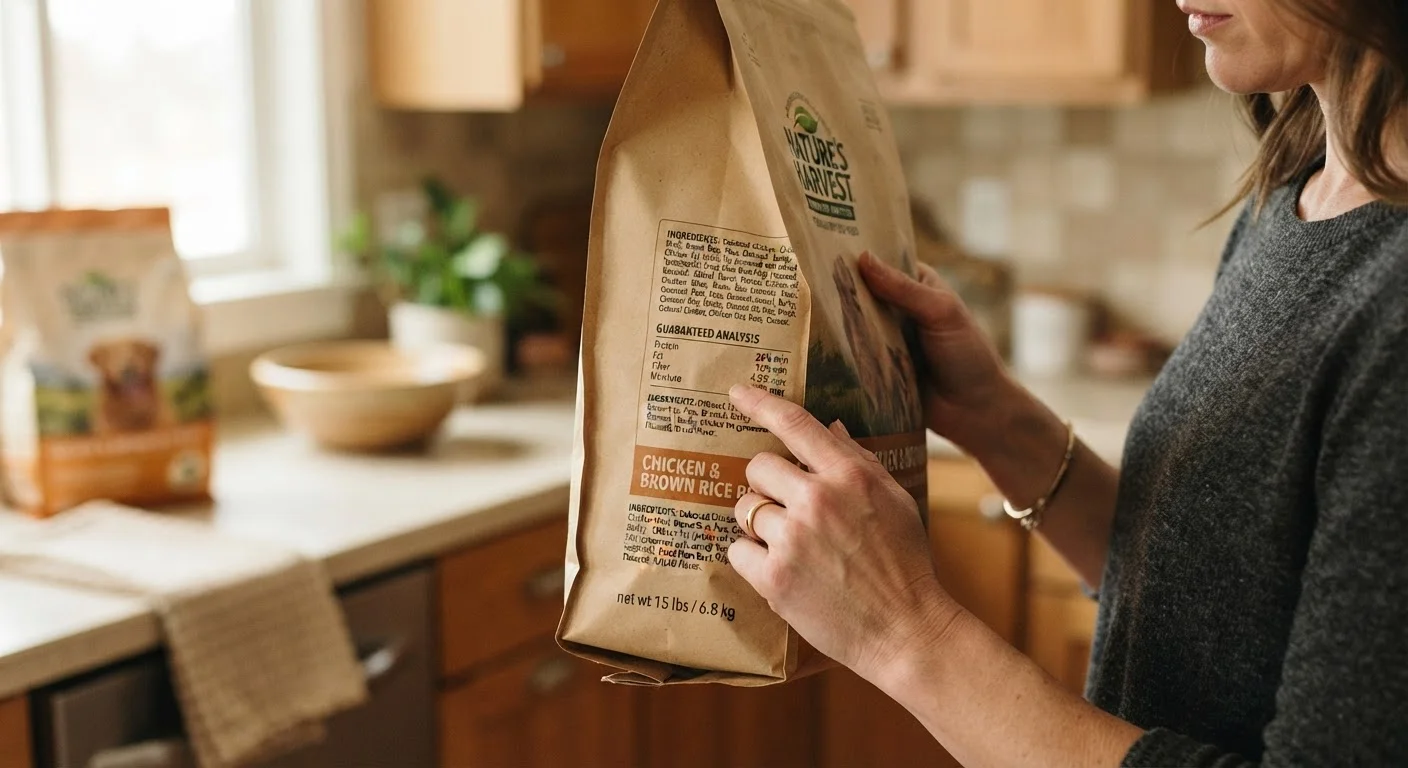
Work through the label from the product name down to the feeding chart. Each section below corresponds to a regulated or meaningful element you will find on virtually any commercially sold pet food in the United States.
Pet food bag or can
The physical label is your primary reference — have it on hand to follow each step in context.
AAFCO official website (aafco.org)
Use to verify nutrient profiles and understand what adequacy statements legally require.
Your veterinarian
Consult for guidance on whether a specific food is appropriate for your individual pet's needs.
Find the product name and identify the '95%,' '25%,' and 'flavor' rules
The product name is regulated. Under AAFCO (Association of American Feed Control Officials) guidelines, if a named ingredient appears in the product title without a qualifier — such as Salmon Cat Food — that ingredient must make up at least 95% of the total weight (excluding water). If a qualifier like dinner, entrée, or formula is used, the named ingredient only needs to comprise 25%. A product labeled with chicken requires just 3% chicken. A food described only by a flavor — chicken flavor — may contain no actual chicken at all, only a detectable taste from a by-product or extract.
Read the ingredient list in order — but understand its limits
Ingredients are listed by descending pre-cooking weight. That means a food listing chicken first contains more chicken by raw weight than any other single ingredient — but after cooking, moisture is lost and the proportions can shift significantly. A cluster of grain or starch ingredients listed lower down may collectively outweigh the top protein once processed.
Also note that ingredient splitting — listing a single ingredient under multiple names (e.g., ground corn, corn gluten meal, corn bran) — can push each sub-item further down the list individually while the combined total remains substantial. For a deeper breakdown of what each ingredient term actually means, see our ingredient list decoding guide.
Decode the guaranteed analysis panel
The guaranteed analysis lists minimums for crude protein and crude fat, and maximums for crude fiber and moisture. These are not precise amounts — a food guaranteeing a minimum of 26% protein could contain significantly more. 'Crude' refers to the measurement method (nitrogen-based for protein, ether extraction for fat), not to quality.
Because moisture varies sharply between dry and wet foods, comparing their guaranteed analyses directly is misleading. Dry kibble typically runs 10–12% moisture; wet food can be 75–80%. To make a meaningful comparison, convert both to a dry-matter basis by dividing the nutrient percentage by the percentage of dry matter (100 minus moisture %).
Locate and interpret the AAFCO nutritional adequacy statement
This statement — typically found near the bottom of the label — is one of the most informative sections. It can read in two distinct ways:
- Formulated to meet AAFCO nutrient profiles: The food was calculated to contain required nutrient levels, but was not tested in live animals.
- Animal feeding tests using AAFCO procedures: The food was fed to animals and passed minimum performance standards over a defined period.
The statement will also specify the life stage the food is intended for: adult maintenance, growth (puppies or kittens), all life stages, or supplemental. A food marked supplemental or intermittent feeding only is not nutritionally complete on its own. Pair this with our guide to dry vs. wet food to understand how format affects overall dietary balance.
Use feeding guidelines as a starting point, not a fixed rule
Feeding guidelines on pet food labels are population-level estimates based on average activity and body weight ranges. They do not account for your individual pet's metabolism, spay/neuter status, health conditions, or activity level. Treat them as an initial reference and monitor your pet's body condition score — a method vets use to assess fat coverage over ribs and spine — to calibrate portions over time.
Changes in coat quality, energy, or weight can all reflect whether a diet is working. Our guide to what your pet's coat reveals covers visible signs that nutrition may need adjustment. For more on body condition assessment beyond the scale, see weight management in pets.
Moisture Content Skews Ingredient Rankings
Wet and dry foods cannot be compared directly using ingredient lists alone because moisture levels differ dramatically. A can of food may list chicken first simply because raw chicken is heavy with water. To compare foods more accurately, look at nutrient levels on a dry-matter basis — your vet can help you calculate this.
Labels Don't Replace Veterinary Guidance
Reading labels more confidently is a valuable skill, but it is not a substitute for professional nutritional assessment. If your pet has a health condition, is at a life stage with specific demands (such as pregnancy or senior years), or is showing signs of digestive upset or coat changes, consult your veterinarian before switching foods. This article provides general educational information, not personalized dietary advice.
This article provides general educational information about pet food labeling. It is not a substitute for personalized veterinary nutritional advice. Always consult a licensed veterinarian for guidance specific to your pet's health and dietary needs.