

Key Takeaways
Why Bodyweight Training Is a Legitimate Starting Point
Many people assume that meaningful fitness progress requires a gym, barbells, or at minimum a set of dumbbells. The evidence suggests otherwise. Bodyweight exercise, when structured around progressive overload and consistent execution, can improve muscular endurance, strength, cardiovascular fitness, and mobility. It is not a compromise - it is a different implementation of the same physiological principles.
The real advantage of training at home without equipment is the elimination of barriers. No commute, no membership cost, no waiting for a machine. For anyone returning to exercise after a long break, removing those barriers can be the difference between a habit that takes root and one that doesn't. If your long-term goals eventually include free weights or gym training, the movement patterns and work capacity you build at home transfer directly - as explored in our overview of free weights versus resistance machines.
What you will need
What You'll Need Before You Begin
The material requirements for home bodyweight training are deliberately minimal. Review the tools below, then follow the step-by-step process that follows.
Exercise mat or folded blanket
Provides cushioning for floor-based movements like planks, push-ups, and core work.
Smartphone timer or interval app
Tracks work and rest periods, removing the need to count reps mentally and keeping sessions paced.
Small notebook or notes app
Logs sessions completed and tracks progression over time - a simple accountability tool.
Step-by-Step: Building Your Routine
Define a realistic session length and frequency
Before choosing a single exercise, decide how much time you can genuinely commit each week. Research on habit formation consistently shows that starting smaller than you think necessary produces better long-term outcomes. For most beginners, three sessions of 20-30 minutes per week is a durable starting point.
Write your sessions into your calendar as fixed appointments. A workout that isn't scheduled is easily displaced by the day's demands.
Anchor your workout to an existing daily habit
Habit science refers to this as "habit stacking" - linking a new behavior to one that's already automatic. Examples include working out immediately after your morning coffee, before your lunch break, or right after dropping kids at school. The existing habit acts as a reliable trigger, reducing the mental friction of deciding when to start.
Build a balanced movement template
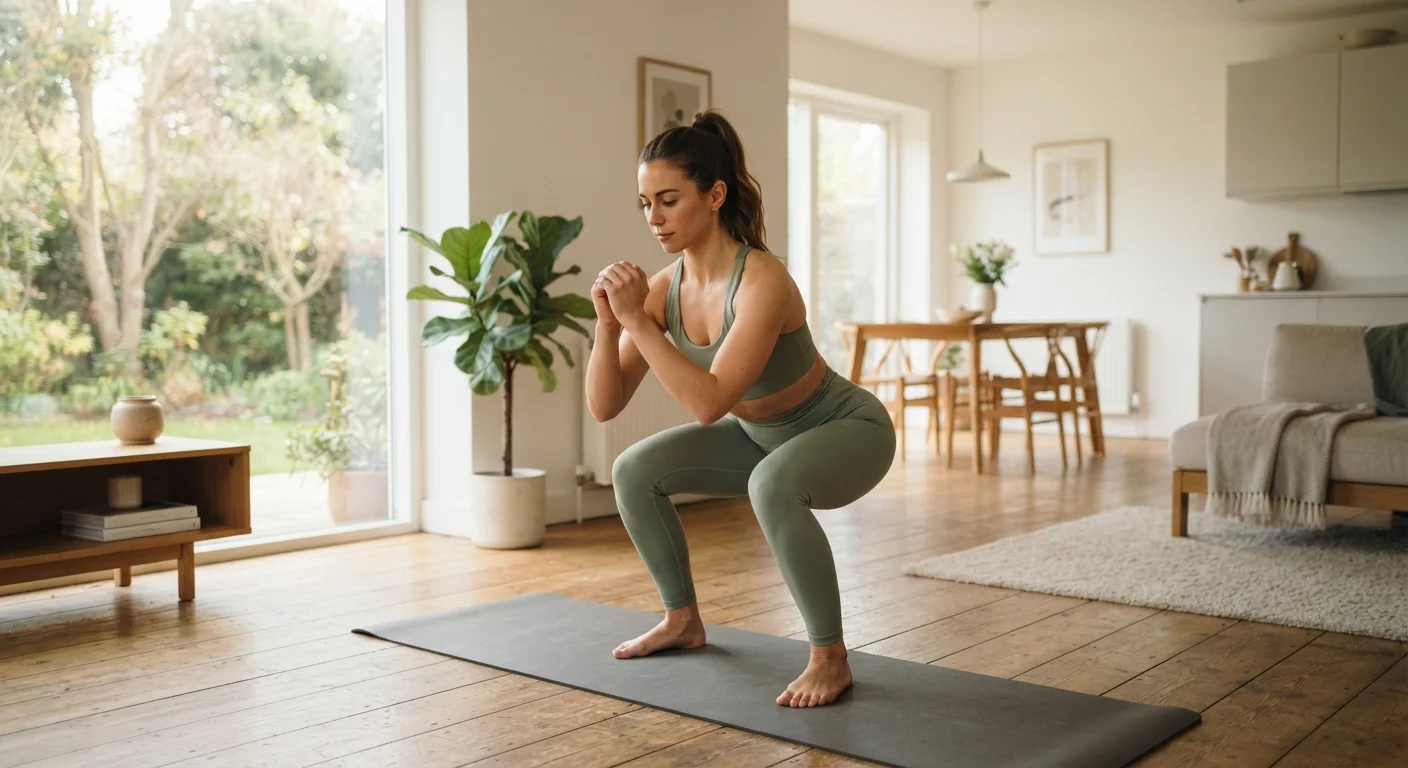
Effective bodyweight training covers four movement patterns: a push (e.g., push-up), a pull substitute (e.g., doorframe row or prone Y-raise), a hinge (e.g., glute bridge), and a squat (e.g., bodyweight squat or split squat). Adding a core stabilization exercise like a plank rounds out a complete session.
A simple template might look like this:
- Push: Push-up variation - 3 sets
- Lower body: Squat or lunge variation - 3 sets
- Hinge: Glute bridge - 3 sets
- Core: Plank hold - 2-3 sets
Rest 60-90 seconds between sets. Total session time lands around 20-25 minutes.
Apply progressive overload without equipment
Progressive overload - the gradual increase in training stimulus - is the engine of physical adaptation. Without weights, you manipulate other variables:
- Reps and sets: Add 1-2 reps per set each week before increasing difficulty.
- Tempo: Slow the lowering phase (e.g., 3-second descent in a squat) to increase muscular time under tension.
- Leverage: Elevate feet for push-ups, progress from two-leg to single-leg glute bridges, move toward pistol squat progressions.
- Rest reduction: Shorten rest periods as fitness improves.
Track, review, and adjust every two to four weeks
Log each session - even briefly. Note which exercises you did, how many sets and reps, and a subjective effort rating (1-10). Every two to four weeks, review your log. If sessions feel consistently easy, apply the progression strategies from Step 4. If you've missed multiple sessions, examine the obstacle: time, soreness, boredom, or schedule disruption.
Understanding why workout routines stall is often more valuable than finding a new program.
Make the First Rep the Only Decision
Motivation is unreliable - structure is not. Lay out your mat, set your timer, and commit only to starting. Research on behavior change consistently finds that beginning an activity is the hardest step; once you're moving, continuation becomes far easier. Treat the first rep as your only obligation.
Sustaining the Habit Over the Long Term
The most common failure point in any home workout routine is not a lack of knowledge about exercise - it's the erosion of consistency after the initial motivation fades. Building systems around your workout reduces reliance on daily willpower. Think of your workout schedule the same way you might approach automating household routines: when decisions are made in advance, execution becomes far easier.
As your fitness improves, your needs will also shift. How the body's strength and recovery needs evolve across decades is worth understanding so you can adapt your programming accordingly rather than hitting a plateau and assuming bodyweight training has stopped working.
Finally, pair your movement habit with attention to nutrition. Exercise and diet are complementary pillars - our Nutrition & Diet hub offers clear, evidence-based guidance to support what you're building here.
This article is for general informational and educational purposes only and does not constitute medical or fitness advice. If you have any health conditions, injuries, or concerns about starting an exercise program, consult a qualified healthcare professional before beginning.