

Key Takeaways
Our Verdict
Free weights and resistance machines each address different aspects of strength development. Free weights build functional strength and coordination, while machines offer controlled, targeted muscle loading with lower technical demand. For most exercisers, a thoughtful combination of both - rather than an either/or choice - produces the most well-rounded results.
| Best for | Recommended |
|---|---|
| Beginners learning movement fundamentals | Resistance Machines |
| Those focused on functional, real-world strength | Free Weights |
| Individuals recovering from injury or managing joint issues | Resistance Machines |
| Experienced lifters seeking comprehensive muscle development | Both Combined |
The Core Difference: Stability vs. Guided Motion
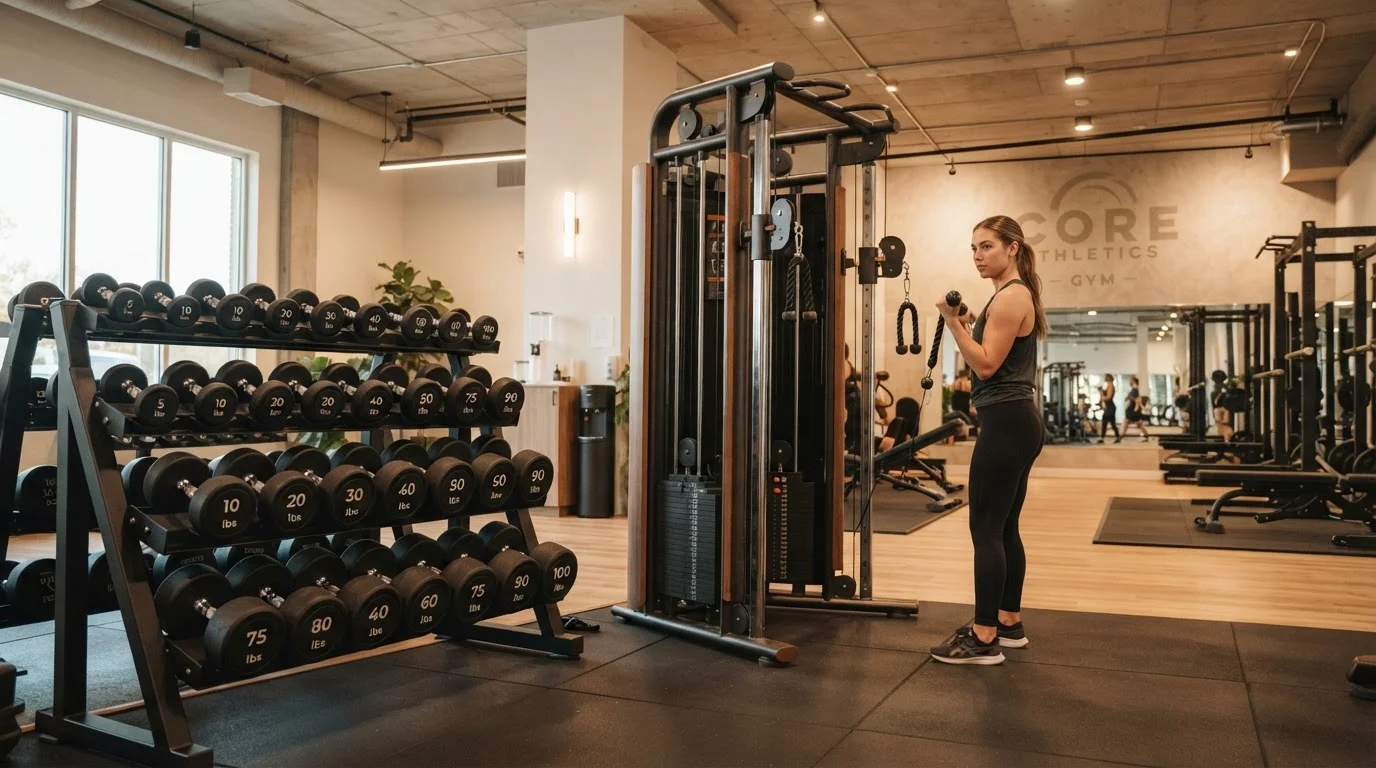
The most fundamental distinction between free weights and resistance machines comes down to how the body is supported during a movement. Free weights - including barbells, dumbbells, and kettlebells - allow the load to move through three-dimensional space. That freedom means your stabilizer muscles, including smaller muscles around joints and your core, must engage continuously to control the weight.
Resistance machines, by contrast, guide movement along a fixed path. That constraint reduces the stabilization demand, directing more effort toward the primary target muscle. Neither approach is inherently better - they simply train different physical qualities. Understanding that distinction helps you deploy each tool where it delivers the most value.
For a broader look at how common assumptions about exercise hold up under scrutiny, see our article on fitness myths and what the evidence actually shows.
| Free Weights | Resistance Machines | |
|---|---|---|
| Stabilizer muscle engagement | High - requires active balance and control | Low - movement path is guided |
| Learning curve | Steep - technique coaching recommended | Gentle - intuitive setup and use |
| Injury risk for beginners | Higher without proper instruction | Lower due to fixed range of motion |
| Muscle isolation | Limited - multiple muscles co-activated | High - targets specific muscle groups |
| Functional carry-over | Strong - mirrors real-world movement | Moderate - more isolated application |
| Accessibility and cost | Moderate - dumbbells usable at home | Low - typically requires gym access |
Muscle Recruitment and Movement Patterns
Research consistently shows that compound free-weight exercises - such as the squat, deadlift, and overhead press - recruit a broader network of muscles simultaneously. A barbell squat, for instance, engages the quads, hamstrings, glutes, spinal erectors, and core in one integrated movement. This pattern mirrors how the body generates force in everyday activities, which is why free-weight training is often associated with improvements in functional strength.
Machine exercises tend to produce high activation in the targeted muscle with less involvement from surrounding tissues. A leg press isolates lower-body pushing muscles without requiring the balance and trunk control a barbell squat demands. This isn't a weakness - it's a feature when the goal is to address a specific muscle group, build volume safely, or work around a limitation that makes free-weight form difficult to maintain.
Use Machines to Extend Training Volume Safely
If your primary compound lifts have depleted your energy and coordination, machines allow you to continue adding productive volume to specific muscles without the technique demands of free weights. This can be especially useful late in a workout when fatigue increases form breakdown risk. Think of machine work as a complement to - not a replacement for - your compound movements.
How these priorities shift across different life stages is explored in our guide on strength training through every decade.
Practical Considerations: Safety, Learning Curve, and Accessibility
For those new to strength training, machines offer a meaningful safety advantage. The guided range of motion makes it easier to learn how a movement should feel before adding load, and the risk of losing control of the weight is substantially lower. Many rehabilitation programs use machines precisely because they allow progressive loading with predictable, joint-friendly mechanics.
Free weights carry a steeper learning curve. Proper technique in compound lifts requires coaching and practice, and poor form under load increases injury risk. That said, proficiency in free-weight movements builds movement competency that extends well beyond the gym.
Don't Skip Technique Training With Free Weights
Loading a barbell or dumbbell before mastering the movement pattern is one of the most common causes of strength-training injuries. If you're new to exercises like the deadlift or overhead press, work with a certified personal trainer or strength coach to establish safe technique first. Video feedback and lighter warm-up sets are practical tools for ongoing form checks even after you have experience.
Accessibility is also worth considering. A set of adjustable dumbbells covers a wide range of free-weight exercises at home. Machines require gym access or significant investment. If you're exploring equipment-free or minimal-equipment options, our guide on building a home workout habit without equipment offers a practical framework.
How to Integrate Both Into One Routine
A pragmatic approach for intermediate and advanced exercisers is to anchor sessions with free-weight compound movements - squats, presses, rows, hinges - and use machines for accessory work targeting specific muscles or adding volume with less systemic fatigue. For example, a lower-body session might open with barbell squats and close with leg curls and leg extensions on machines.
Beginners may benefit from starting predominantly on machines to build a foundation of strength and body awareness, gradually introducing free-weight movements as form improves. Those managing injuries should work with a physical therapist or certified trainer to identify which modality is appropriate for their specific situation.
~2x
Greater core activation with free weights
Studies comparing free-weight and machine squat variations have found meaningfully higher trunk muscle activation during barbell exercises, reflecting the stabilization demand.
58%
Adults not meeting strength training guidelines
According to CDC data, a majority of U.S. adults do not meet the recommended muscle-strengthening activity levels - suggesting any form of consistent resistance training is beneficial.
The goal is a routine that is sustainable, progressive, and aligned with your individual needs - not one that rigidly favors one tool over the other.
This article is for general informational and educational purposes only and does not constitute medical or professional fitness advice. Consult a qualified healthcare provider or certified strength and conditioning professional before beginning any new exercise program, particularly if you have existing health conditions or injuries.