

Key Takeaways
Why Small-Space Decorating Advice Gets Oversimplified
Most small-space decorating tips were born from sound instincts - light bounces off pale walls, a clear floor feels open, clutter closes in fast. The problem is that these observations get compressed into hard rules that strip away the nuance designers actually rely on. The result is a set of conventions that can leave small rooms feeling timid, monotonous, and strangely less functional than they could be.
The myth-and-fact pairs below tackle the most common of these oversimplifications. Each one addresses a belief that's partly true in theory but routinely misapplied in practice. Understanding why a rule exists is more useful than following it blindly - and it gives you the flexibility to break it when your space calls for something different.
Myth
You must always use light, neutral colors in a small room to make it feel bigger.
Fact
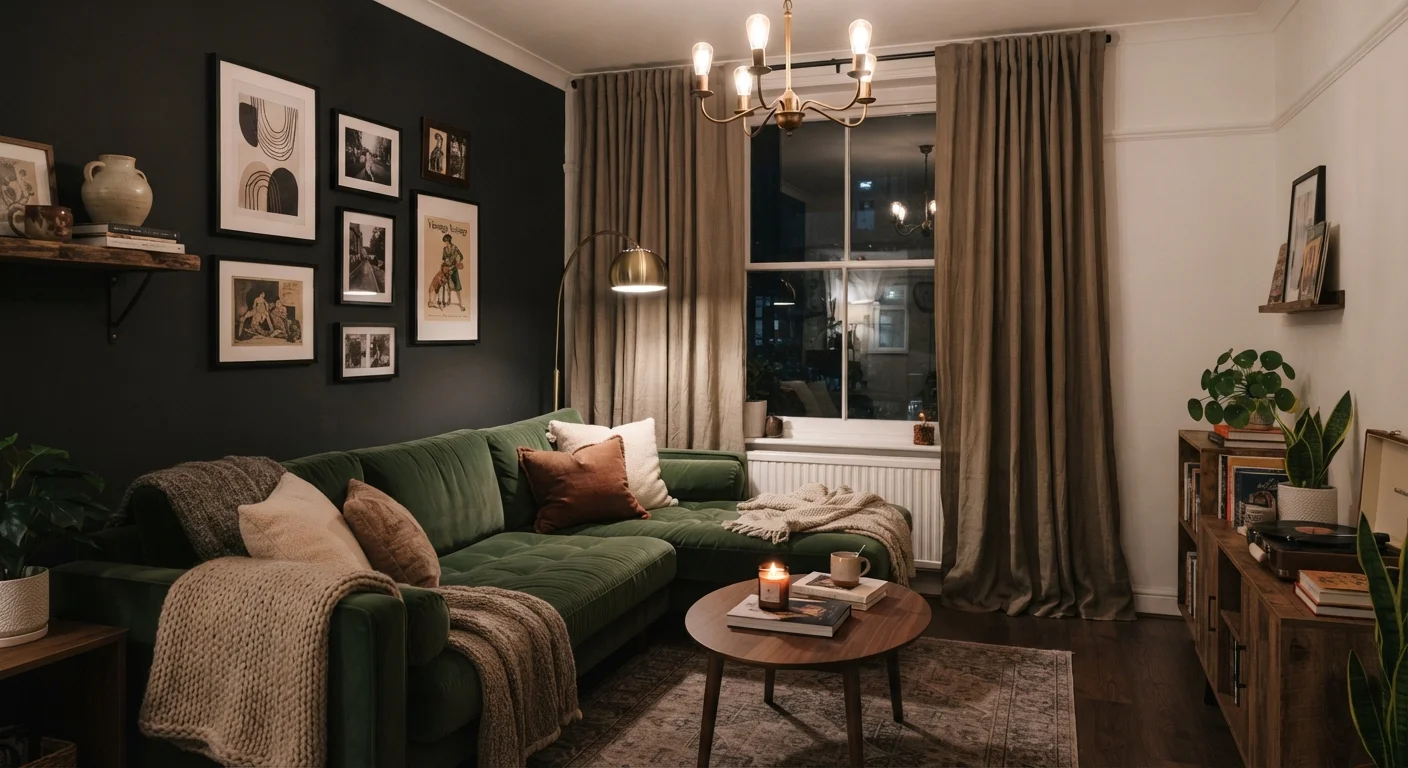
Dark, saturated colors can actually make a small room feel more intentional, cocooning, and visually interesting - especially in rooms with limited natural light.
The logic seems sound: light reflects more in pale rooms, therefore pale rooms feel larger. And light colors do open a space up. But designers routinely use deep greens, navy blues, and charcoal grays in compact rooms - not despite the size, but because of it. A consistent dark color on all four walls and the ceiling eliminates the boundaries that define a room as small. The eye stops tracking edges and starts reading the space as an atmosphere. The result is a room that feels rich and deliberate rather than squeezed. If you're curious about building a palette that works for your space, our color decorating guide walks through the fundamentals in plain terms.
Myth
Big furniture is always wrong in a small space - stick to small-scale pieces only.
Fact
One or two larger, well-proportioned pieces often read better in a small room than a collection of many small ones that create visual clutter.
A room filled exclusively with small-scale furniture tends to feel busy and uncertain rather than spacious. A single substantial sofa or a full-sized dining table gives the eye a clear anchor, while too many petite pieces compete for attention without establishing any hierarchy. The real principle here is scale and proportion - understanding how objects relate to each other and to the room. Pieces with open bases (such as sofas on legs or glass-topped tables) let light pass underneath and maintain visual airiness even at a larger size. For a deeper look at how furniture scale affects composition, see the core principles of interior design.
Myth
All furniture should be pushed against the walls to maximize floor space.
Fact
Floating furniture away from walls - even by just a few inches - often makes a room feel more composed and intentional, while wall-hugging layouts can create awkward dead zones.
This is one of the most persistent small-space instincts, and it's understandable: keeping furniture at the perimeter seems to preserve open floor area. In practice, it often produces a ring of furniture around empty center space that feels hollow and hard to use. Pulling a sofa a few inches away from the wall, or positioning two chairs at a slight angle toward each other, creates conversation zones that feel purposeful. Good furniture arrangement is less about maximizing raw floor area and more about making the available space feel usable and connected.
Myth
Small rooms need small rugs so the floor shows and the room looks bigger.
Fact
An undersized rug makes a room feel disconnected and smaller; a properly sized rug that anchors all major furniture legs reads as more spacious.
A rug that's too small acts like an island in the middle of the room - unmoored and awkward. Designers generally recommend that at least the front legs of all key seating pieces rest on the rug. This grounds the furniture grouping as a single visual unit, which paradoxically makes the room feel larger and more complete. In a small bedroom, a rug that extends beyond the bed frame on three sides creates a sense of generosity and finish that a bedside-only runner cannot. Textiles like rugs do more work in a room's perception than most people realize.
Myth
Mirrors are a guaranteed fix for any small room - more mirrors always help.
Fact
Mirrors add depth and light effectively only when placed deliberately; randomly adding mirrors can create visual chaos or reflect unflattering views.
Mirrors work by borrowing light and reflecting a portion of the room back to the viewer, which can create the illusion of depth. But a mirror that faces a cluttered corner, a plain wall, or a dark hallway simply doubles the problem. The most effective placements reflect a window, a well-lit focal point, or an attractive part of the room. A large, well-placed mirror reads as architectural; a random scatter of small mirrors reads as decoration without direction. Think of mirrors as editing tools - they amplify whatever they face, so be intentional about what that is.
Putting It Together: What Actually Works in Small Spaces
The common thread across these myths is a misunderstanding of how visual perception works in a room. Spaciousness isn't just about physical dimensions - it's about how the eye moves, where it rests, and how clearly the room's purpose is communicated. A dark, cohesive room can read as more expansive than a pale, cluttered one. A single large sofa can feel less overwhelming than five mismatched chairs.
Don't Swap One Myth for Another
Learning that dark colors can work in small rooms doesn't mean every small room needs dark walls. Context matters: how much natural light a room gets, what the ceiling height is, and how the space is used all affect whether a bold choice enhances or overwhelms. Test paint samples at different times of day before committing.
Practical decorating decisions - furniture scale, color saturation, rug sizing, lighting - work as a system rather than a checklist. Adjusting one element affects how the others read. If you're working through a refresh without replacing major pieces, small targeted changes to textiles, accessories, and arrangement can meaningfully shift how a compact room feels. And for anyone starting from scratch with a design concept, reviewing how different interior styles approach space can help clarify which direction suits your habits and taste.
Rules Are Starting Points, Not Laws
Decorating guidelines - including the ones in this article - describe tendencies, not guarantees. Every room has a unique shape, light quality, and purpose. Use these myth-busting points as permission to experiment, not as a new set of rules to follow rigidly.
~600 sq ft
Average size of a U.S. studio apartment
According to U.S. Census Bureau housing data, studio and one-bedroom units in urban areas commonly fall below 700 square feet, making small-space decorating a practical concern for millions of renters and homeowners.
3-in-1
Roles a well-placed rug plays
Interior designers frequently describe rugs as performing triple duty: defining a zone, adding acoustic warmth, and visually anchoring furniture - making rug sizing one of the highest-impact decisions in a small room.