Key Takeaways
Our Verdict
Each insulation type occupies a distinct niche. Batts and blown-in are the go-to options for most residential retrofits and new construction because they are widely available and relatively straightforward to install. Rigid foam and spray foam step in where continuous coverage and air sealing are the priority, but they typically call for professional expertise. Matching the insulation type to the specific location and construction context - rather than choosing one material for the entire house - tends to produce the best overall results.
| Best for | Recommended |
|---|---|
| Open wall cavities in new construction or full renovations | Batt insulation |
| Attics and irregularly shaped or obstructed spaces | Blown-in insulation |
| Basement walls, exterior sheathing, and under-slab applications | Rigid foam board |
| Rim joists, crawl spaces, and areas requiring maximum air sealing | Spray foam insulation |
Why Insulation Type Matters Beyond R-Value
Most homeowners know that insulation keeps a house warmer in winter and cooler in summer, but the conversation often stops at R-value - a measure of resistance to heat flow. While R-value matters, it tells only part of the story. Two insulation materials can share the same R-value per inch yet perform very differently depending on how well they fill a cavity, whether they also block air movement, and how moisture behaves around them over time.
Choosing the right insulation type for a specific location in your home can affect comfort, indoor air quality, and long-term building health. Understanding the four most common residential insulation materials gives you the vocabulary to have a more informed conversation with a contractor - or to plan a project yourself where appropriate.
It's also worth pairing insulation with good air sealing. No insulation performs at its rated value if air can freely move around it. For gaps around windows, doors, and joints, see our guide to caulk versus weatherstripping for complementary strategies.
The Four Main Insulation Types Compared
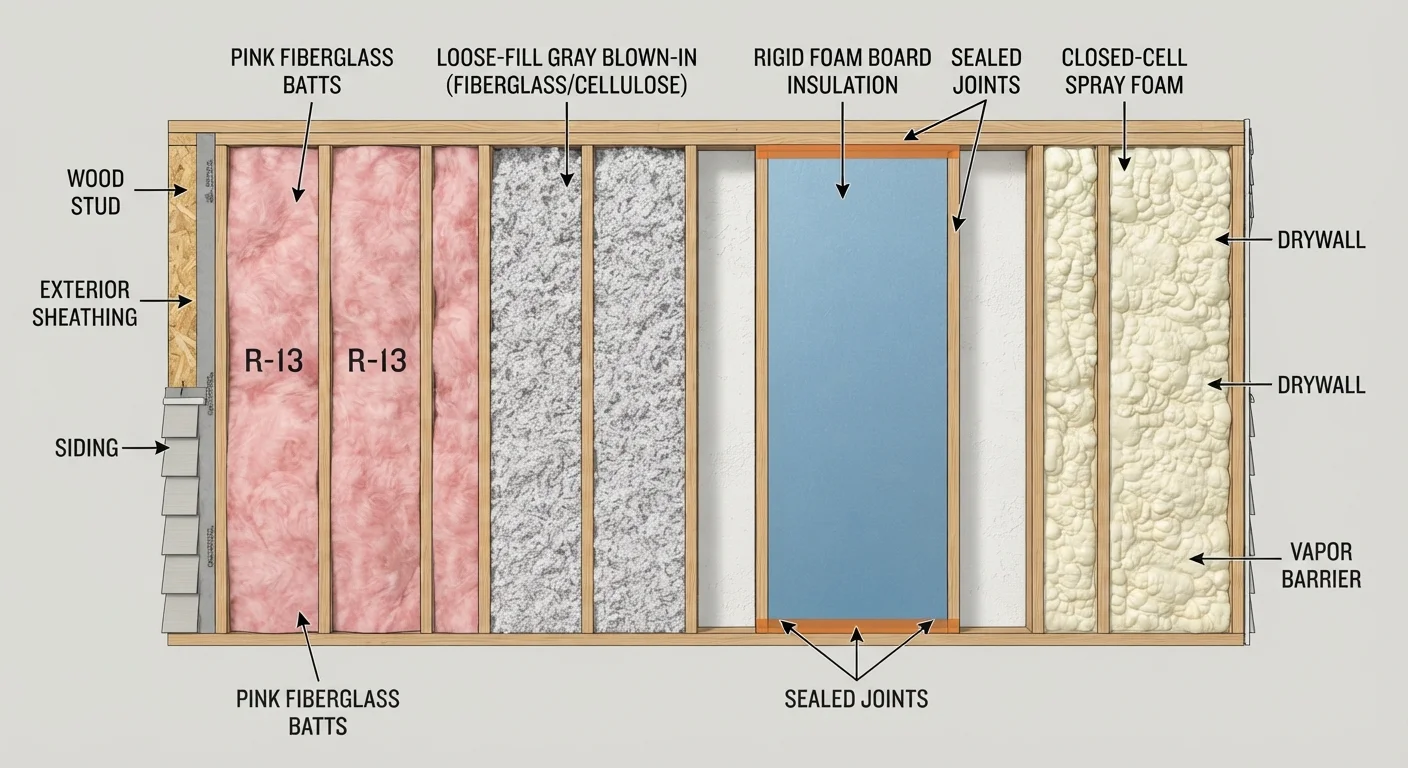
Each of the four insulation types below has a particular set of strengths. The comparison table summarizes how they stack up across the criteria that matter most to homeowners planning a project.
| Batt | Blown-In | Rigid Foam | Spray Foam | |
|---|---|---|---|---|
| Typical R-value per inch | ~R-3 to R-4 | ~R-3 to R-3.7 | ~R-3.8 to R-6.5 | ~R-3.7 to R-6.5 |
| Best locations | Open wall cavities, floors | Attics, retrofit walls | Exterior sheathing, basements | Rim joists, crawl spaces |
| Air sealing ability | Low | Low to moderate | Moderate (when taped) | High (closed-cell) |
| DIY accessibility | Moderate | Moderate (rented blower) | Moderate | Low - professional recommended |
| Typical material cost | Lower | Lower to moderate | Moderate to higher | Higher |
| Moisture considerations | Can hold moisture if wet | Cellulose dries well | Varies by foam type | Closed-cell resists moisture |
Keep in mind that local climate, existing construction details, and whether the work is new construction or a retrofit will all influence which option - or combination of options - makes the most sense for your situation.
Batt and Blown-In: The Accessible Options
Batt insulation - sold in pre-cut panels or rolls - is the material most people picture when they think of insulation. It typically consists of fiberglass or mineral wool and is sized to fit standard wall stud and floor joist spacing (usually 16 or 24 inches on center). Batts are among the more accessible insulation options for homeowners comfortable with basic safety precautions: gloves, a dust mask or respirator, and eye protection are important when handling fiberglass.
Their main limitation is fit. A batt that is compressed, torn around obstructions, or installed with gaps loses effective R-value, so careful cutting and placement matter.
Blown-in insulation (also called loose-fill) uses a blower machine to distribute loose fibers - typically cellulose or fiberglass - across a surface or into enclosed cavities. It conforms naturally around wires, pipes, and other obstacles, making it well suited for attic floors and wall cavities in retrofit situations where batts cannot be inserted easily. Cellulose, made largely from recycled paper, is treated for fire resistance and has a relatively low embodied energy.
Renting a Blower for Blown-In Projects
Many home improvement centers offer blower machine rentals when you purchase a minimum quantity of loose-fill insulation. This can make attic top-ups a manageable weekend project for a homeowner comfortable working in an attic space. Always wear a properly rated dust mask or respirator, eye protection, and long sleeves, and confirm your attic has adequate ventilation pathways before adding material.
Rigid Foam and Spray Foam: Higher Performance, Greater Complexity
Rigid foam board comes in panels of extruded polystyrene (XPS), expanded polystyrene (EPS), or polyisocyanurate (polyiso), each with slightly different R-values per inch and moisture characteristics. Its key advantage is providing a continuous layer of insulation with no thermal bridging through studs - a common weak point with batt-only wall assemblies. Rigid foam is often installed on exterior wall sheathing, under basement slabs, or along basement and crawl space walls. Joints between panels should be taped or sealed to minimize air movement.
Because rigid foam against a basement wall changes how moisture moves through that assembly, it is worth reviewing moisture management strategies alongside installation - our basement waterproofing overview covers the broader context.
Spray polyurethane foam (SPF) is applied as a liquid that expands and hardens in place. Open-cell spray foam is softer and vapor-permeable; closed-cell spray foam is denser, with a higher R-value per inch and a low vapor permeance that can act as both insulation and vapor retarder in a single layer. Spray foam's ability to fill every gap makes it the strongest air-sealing insulation available, but its chemical components require proper respiratory protection during application and adequate off-gassing time before occupancy. Professional installation is strongly recommended.
Spray Foam Requires Ventilation and Curing Time
Spray polyurethane foam releases isocyanates and other compounds during and shortly after application. These chemicals can cause respiratory sensitization. Occupants and pets should vacate the space during application and for the period the manufacturer specifies before re-entry - typically at least 24 hours, though this varies by product. Never re-enter a freshly sprayed space before it has fully cured. Professional installers should be equipped with appropriate respiratory protection and be trained in safe handling procedures.