Key Takeaways
Option A
Caulk
The permanent filler for stationary cracks and gaps.
Best for: Sealing fixed, non-moving joints between surfaces like window frames and walls, or around pipes and fixtures.
Option B
Weatherstripping
The flexible seal designed for moving parts.
Best for: Sealing the perimeter of doors and operable windows that open and close repeatedly.
If you need to seal around window frames, baseboards, or where two stationary surfaces meet
Caulk
Caulk bonds rigidly to both surfaces, creating a long-lasting airtight seal that doesn't degrade from compression or friction.
If you need to seal a door or operable window that opens and closes daily
Weatherstripping
Weatherstripping is engineered to compress and recover repeatedly without cracking, maintaining a seal through thousands of open-close cycles.
If you want a full air-sealing upgrade for maximum comfort and efficiency
Both
A thorough approach uses caulk on fixed joints and weatherstripping on movable components - each material covering the gaps the other can't.
Why Air Sealing Matters Before You Choose a Material
Gaps around doors, windows, pipes, and structural joints are among the most common sources of energy loss in American homes. Outside air infiltrates in winter and summer alike, making heating and cooling systems work harder. Before choosing a sealant, it helps to understand that air sealing isn't one-size-fits-all - the movement (or lack of movement) at a gap determines which material belongs there.
Caulk and weatherstripping are complementary, not interchangeable. Most homes need both, applied in the right locations. See our seasonal maintenance checklist for a broader look at when to inspect and refresh these seals throughout the year.
| Criterion | Caulk | Weatherstripping |
|---|---|---|
| Best application | Fixed, stationary joints and cracks | Movable doors and operable windows |
| Movement tolerance | None - cracks under repeated stress | High - designed to compress and rebound |
| Common materials | Latex, silicone, polyurethane | Foam, V-strip, rubber, felt, door sweeps |
| Typical lifespan | 5-10 years in good conditions | 1-10 years depending on type and traffic |
| DIY difficulty | Low to moderate (surface prep is key) | Low (most types are peel-and-stick or screw-on) |
| Paintable | Yes (latex); No (silicone) | Generally no |
| Where NOT to use | Door/window perimeters that move | Fixed cracks in walls, siding, or masonry |
Where Caulk Belongs - and Which Type to Use
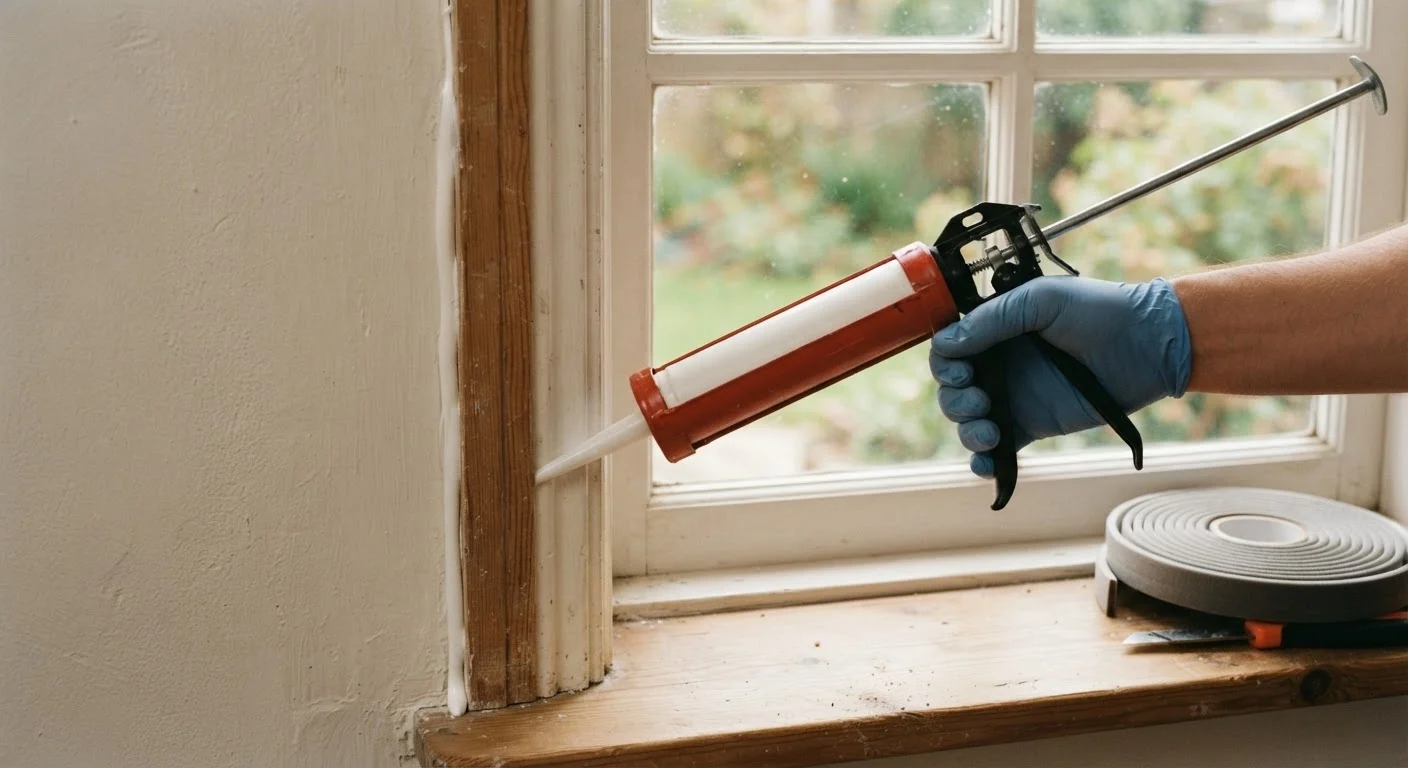
Caulk is a flexible sealant that cures to form a rigid or semi-rigid bond between two stationary surfaces. It's the right choice wherever two non-moving materials meet: the joint between a window frame and exterior siding, the gap where a pipe enters a wall, the seam between a bathtub and tile, or the crack between baseboard and flooring.
The two most common types are latex (acrylic) caulk and silicone caulk. Latex caulk is paintable, easier to tool, and cleans up with water - making it well suited for interior trim work. Silicone caulk offers superior flexibility and moisture resistance, which makes it the better choice for kitchens, bathrooms, and exterior applications exposed to rain and temperature swings.
One critical rule: never apply caulk across a joint that moves. If the two surfaces shift relative to each other - as door frames do when a door opens - caulk will crack and fail quickly. For gaps around the foundation or basement walls, also consider reading about basement waterproofing strategies, since sealants used below grade serve a related but distinct purpose.
25-30%
Home heating/cooling loss from air leaks
The U.S. Department of Energy estimates that air leakage through gaps and cracks accounts for roughly 25-30% of heating and cooling energy use in typical homes.
$0.50-$3
Typical cost per linear foot for weatherstripping
Weatherstripping materials vary widely by type, with foam tape at the lower end and reinforced rubber or metal V-strip at the higher end of the range.
Where Weatherstripping Belongs - and Which Type to Use
Weatherstripping is designed specifically for movable components. Every time a door or operable window opens and closes, the seal compresses and rebounds. No caulk can survive that kind of repeated mechanical stress - but weatherstripping is engineered for exactly that purpose.
The main types include:
- Foam tape: Self-adhesive, easy to install, and effective for low-traffic windows or rarely used doors. It compresses well but wears out faster than other options.
- V-strip (tension seal): A durable plastic or metal strip folded into a V shape that springs open to maintain contact. Well suited to the sides of double-hung windows and door stops.
- Door sweeps: Attached to the bottom of a door, these seal the gap between the door and threshold - a common source of drafts and pest entry.
- Reinforced felt or rubber: Durable options for door stops and jambs, with varying lifespans depending on material quality and door traffic.
Choosing the right weatherstripping depends on how much friction and compression the seal will experience. High-traffic exterior doors benefit from more robust materials, while interior or casement windows can often use simpler foam or felt options. For a deeper look at how sealing works alongside insulation, the insulation types guide covers the complementary role insulation plays in a whole-home efficiency strategy.
Common Mistakes - and How to Avoid Them
The single most frequent error homeowners make is applying caulk to a door frame perimeter instead of weatherstripping. It looks neat at first but breaks down within weeks of regular door use. The reverse mistake - placing foam weatherstripping tape over a fixed crack in siding - leaves gaps wherever the tape doesn't fully conform to an irregular surface.
Other pitfalls to avoid:
- Skipping surface prep: Both caulk and weatherstripping adhere poorly to dirty, oily, or damp surfaces. Clean and dry the area thoroughly before applying either material.
- Leaving old, failed caulk in place: Layering new caulk over cracked or peeling caulk traps air and moisture beneath, causing the new layer to fail faster. Remove old material completely.
- Oversizing the bead: A caulk bead that's too thick takes longer to cure, may shrink unevenly, and is harder to tool smoothly. Aim for a consistent, modest bead matched to the gap size.
- Ignoring the threshold gap: The bottom of an exterior door is often overlooked. A door sweep is one of the easiest weatherstripping upgrades and one of the most impactful for draft control.
When to Call a Professional
Most caulking and weatherstripping projects are straightforward DIY tasks. However, large gaps in exterior walls, foundation cracks, or deterioration around structural elements may signal underlying issues that go beyond cosmetic sealing. In those cases, consulting a licensed contractor or energy auditor is a sound step before applying any sealant. A professional energy audit can also use blower-door testing to pinpoint air leakage locations you might not spot visually.