

Key Takeaways
Why Credit Myths Persist - and Why They're Costly
Credit scores shape whether you qualify for a mortgage, an auto loan, or even certain rental agreements. Yet a surprising number of people navigate their finances using information that is simply wrong. These myths don't just cause confusion - they lead to real decisions that can suppress a score for years.
Understanding how credit actually works is a foundational financial skill. If you want to go deeper on the mechanics, Credit Scores Explained: What the Number Actually Measures walks through how each component is weighted. For now, let's address the misconceptions that do the most damage.
Myth
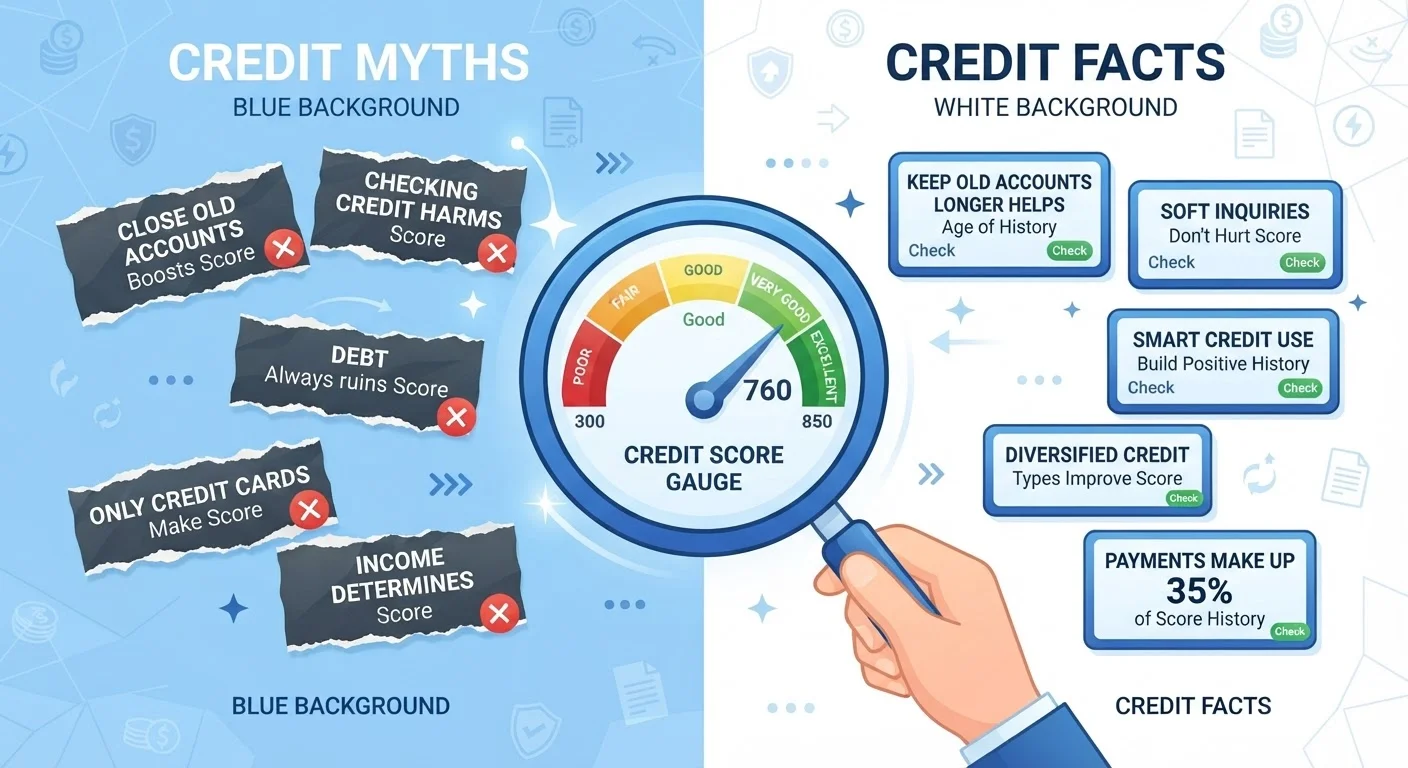
Checking your own credit score will lower it.
Fact
Checking your own score is a soft inquiry and has no effect on your credit score whatsoever.
Credit inquiries come in two forms: soft inquiries (such as checking your own score or a lender doing a background pre-qualification) and hard inquiries (when a lender formally reviews your credit after you apply for new credit). Only hard inquiries can temporarily affect your score - and even then, the impact is typically small and short-lived.
You can and should check your own credit regularly. Free access to your credit reports is available through AnnualCreditReport.com, the official site established under federal law. Errors are more common than most people expect - and you can't catch them if you're afraid to look.
Myth
Carrying a small balance on your credit card helps build credit.
Fact
Paying your balance in full each month demonstrates responsible credit use and costs you nothing in interest.
This myth likely originates from a misunderstanding of how credit utilization is reported. Carrying a balance does show activity - but it doesn't earn you any extra credit-building benefit. What matters to scoring models is that you use credit and pay as agreed, not that you carry debt from month to month.
When you carry a balance, you pay interest - often at rates well above 20% annually on many cards. That's a real cost for zero scoring benefit. Pay your statement balance in full each month: you demonstrate responsible behavior and keep your utilization low, both of which support a stronger score over time.
Myth
Closing a credit card you don't use will improve your score.
Fact
Closing an account can raise your credit utilization ratio and shorten your credit history, both of which may lower your score.
When you close a card, you lose that card's available credit limit. If you still carry balances on other cards, your overall utilization ratio - balances ÷ total available credit - rises, which scoring models view negatively. Additionally, older accounts contribute positively to the average age of your credit history, another scoring factor.
This doesn't mean you should never close a card. But it's worth weighing the tradeoffs carefully. Why Closing Old Credit Cards Can Hurt Your Score explains the credit mechanics in detail so you can make an informed decision.
Myth
Your income directly affects your credit score.
Fact
Credit scores do not factor in income, employment status, or net worth - only your credit behavior.
Credit scores are calculated from data in your credit report, which includes payment history, amounts owed, length of credit history, credit mix, and new inquiries. None of those categories include income. A high earner who misses payments will have a worse score than a modest earner who always pays on time.
Lenders may separately consider income when evaluating loan applications - that's a debt-to-income assessment - but it is distinct from your credit score. Understanding this distinction helps clarify why two people with similar salaries can have very different scores. For a full breakdown of credit terminology, credit terms explained at every financial milestone is a useful reference.
Myth
You only have one credit score.
Fact
There are multiple credit scoring models, and your score can vary meaningfully depending on which bureau and model is used.
FICO and VantageScore are the two dominant scoring frameworks in the U.S., and each has multiple versions. Add to that the fact that your data may differ slightly across the three major credit bureaus - Equifax, Experian, and TransUnion - and it becomes clear why a score you see on one platform may not match what a lender pulls.
What matters most is not hitting an exact number on one model, but maintaining strong fundamentals across the board: low utilization, consistent on-time payments, and a clean report. Those habits translate well regardless of which scoring model a lender uses.
What Actually Moves Your Score
Once you strip away the myths, a clearer picture emerges: your score is largely a reflection of whether you borrow responsibly, keep balances low relative to your limits, and pay on time - consistently. These aren't shortcuts or tricks; they're durable habits.
35%
Payment history's share of a FICO score
According to FICO's publicly published score factor breakdown, payment history is the single largest component of the standard FICO scoring model.
30%
Amounts owed (utilization) weight in FICO
Credit utilization - how much of your available revolving credit you're using - accounts for roughly 30% of a FICO score, making it the second most influential factor.
1 in 5
Americans with a credit report error
A study by the Federal Trade Commission found that approximately one in five consumers had an error on at least one of their three major credit bureau reports.
Late payments carry especially heavy weight. A single missed payment can affect your report for up to seven years under federal credit reporting rules. That's worth internalizing: the damage from one overlooked bill can outlast a car loan.
Credit utilization - the share of your available revolving credit currently in use - is the second most influential factor. Keeping this figure below 30% is a widely cited guideline, and lower is generally better. Reading Your Credit Report Without Getting Lost can help you spot utilization problems before they compound.
One Late Payment Can Follow You for Years
Under the Fair Credit Reporting Act, most negative items - including late payments - can remain on your credit report for up to seven years from the date of the original delinquency. This makes payment history the single highest-leverage habit to protect. Setting up autopay for at least the minimum payment due is one of the most reliable safeguards against accidental damage to your score.
If you want to move beyond myth-busting and toward active improvement, Habits That Quietly Strengthen a Credit Score Over Time offers a grounded, evidence-based path forward. And if misconceptions are tripping you up in other areas of personal finance, it's worth checking whether budget myths are keeping you from starting too.
This article is for general informational and educational purposes only and does not constitute personalized financial or legal advice. Credit scoring models and reporting rules can vary. For guidance specific to your situation, consider consulting a qualified financial adviser or licensed credit counselor.