

Key Takeaways
Why the 'Cats Can't Be Trained' Myth Persists
Cats have long been cast as aloof, independent, and fundamentally uninterested in cooperating with humans. Unlike dogs — domesticated over millennia for working partnerships — cats were historically kept for pest control, not obedience. That origin story has calcified into a cultural assumption: that cats simply don't respond to training the way other animals do.
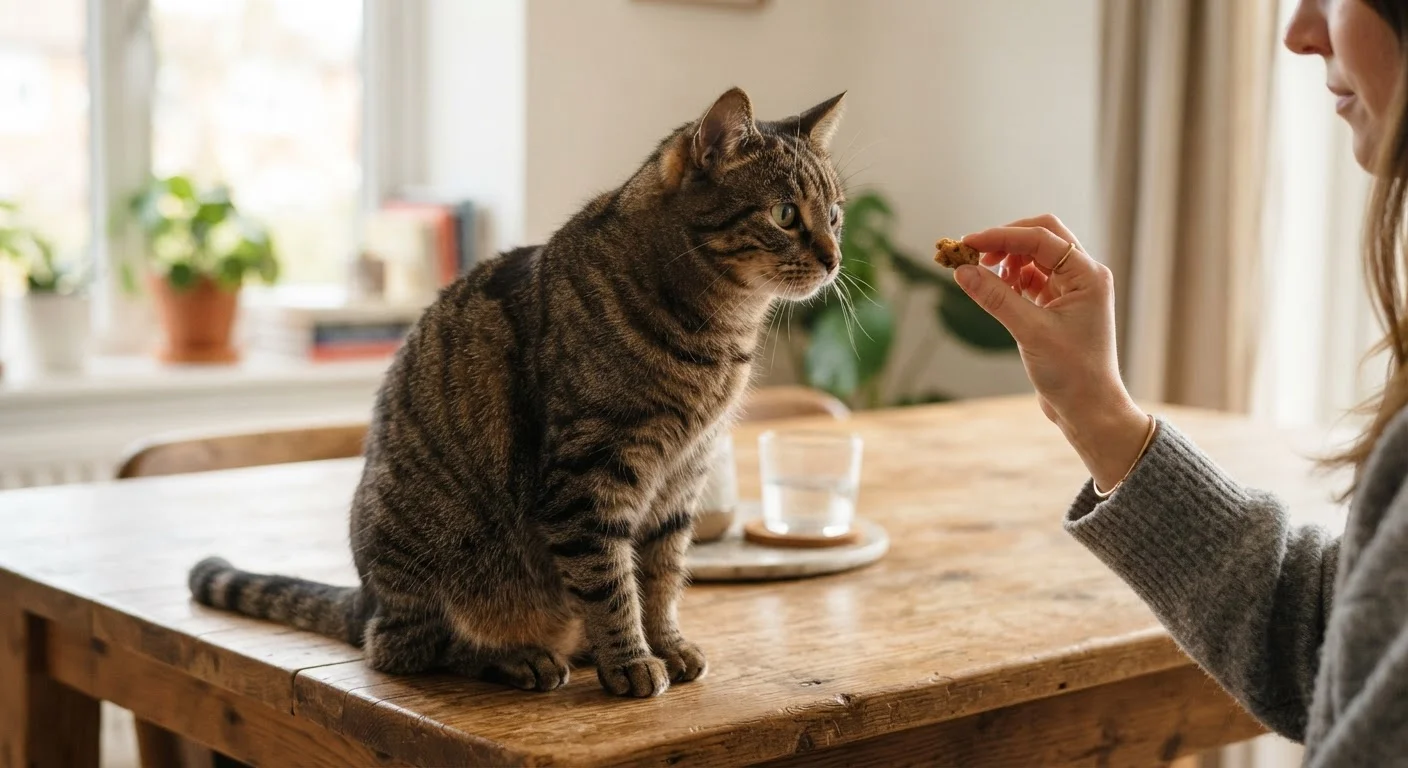
But animal behaviorists and veterinary professionals tell a different story. Cats are highly capable learners. They respond readily to operant conditioning — particularly positive reinforcement — and can acquire a wide range of behaviors, from simple sit commands to complex litter habits and carrier acceptance. The real barrier isn't feline biology; it's owner expectation and technique.
For a broader look at how training principles apply across species, see this beginner's guide to pet training.
Myth
Cats are too independent to be trained — they simply don't want to cooperate with humans.
Fact
Independence is a personality trait, not a learning barrier. Cats respond reliably to positive reinforcement regardless of temperament.
Feline independence refers to how cats navigate social hierarchies and explore their environment — it does not mean they are incapable of learning from consequences. Studies in animal cognition have shown that cats can learn object names, respond to their own names, and follow human pointing gestures. The error is confusing a cat's selective attention with an inability to learn. A cat that ignores a cue it finds unrewarding is demonstrating normal behavior, not obstinacy.
Myth
You can only train kittens — older cats are set in their ways.
Fact
Adult and senior cats are fully capable of learning new behaviors. Neuroplasticity does not shut off after kittenhood.
The idea that learning windows close in early life applies to some specific developmental processes — such as socialization to humans — but not to operant learning. Adult cats acquire new behaviors through reward-based training routinely. Veterinary behaviorists regularly work with middle-aged and senior cats to address litter box problems, fear responses, and handling avoidance. The pace of learning may be somewhat slower in older cats, and patience is especially important, but age alone is not a disqualifier.
Myth
Punishment is an effective way to stop unwanted cat behavior.
Fact
Punishment rarely suppresses behavior reliably and often increases stress, fear, and avoidance — damaging the cat-owner bond.
Punishment in animal training requires precise timing, consistent application, and an aversive experience significant enough to suppress the behavior — conditions that are nearly impossible to achieve humanely with cats. More often, owners apply punishment inconsistently and after a delay, which teaches the cat nothing useful about the behavior. What it does teach is that the owner is unpredictable and potentially threatening. The American Association of Feline Practitioners and the ASPCA both recommend against punishment-based methods in favor of environmental management and positive reinforcement.
Myth
Cats don't respond to rewards — they're not food-motivated enough.
Fact
Most cats are highly food-motivated; the issue is usually treat selection, timing, or session length — not the cat's interest in rewards.
Reward value is not universal. A treat a cat finds merely palatable will produce weak learning compared to one it finds highly desirable. Finding the right motivational currency — whether that's a particular food, a brief play session, or gentle physical contact — is the trainer's job. Cats also have much shorter training windows than dogs. A session longer than five minutes often produces disengagement, which owners misread as the cat being uninterested. Adjusting reward quality and session length often transforms results dramatically.
Myth
Cats scratch furniture and exhibit other problem behaviors out of spite.
Fact
Problematic behaviors in cats almost always reflect unmet behavioral needs or inadequate environmental setup — not intentional retaliation.
Spite requires a theory of mind that attributes intentional harm to another's feelings — a cognitive capacity that has not been demonstrated in cats. Scratching, for instance, is a natural feline behavior serving communication, claw maintenance, and stretching needs. When cats scratch furniture, it typically means appropriate scratching outlets are absent or poorly positioned. Redirecting the behavior by providing suitable scratching surfaces in the right locations is far more effective than any punitive response — and it addresses the actual cause.
What the Science Actually Shows
Research in comparative psychology consistently demonstrates that cats learn through the same fundamental mechanisms as dogs and other mammals. A cat's brain responds to consequences: behaviors that produce something rewarding tend to be repeated; behaviors that produce nothing tend to fade. This is the core of operant conditioning, and it works on cats.
79%
Cats responded to their own name
A 2019 study published in Scientific Reports found that the majority of domestic cats could distinguish their own name from other words — even when called by strangers.
2–5 min
Optimal cat training session length
Animal behaviorists generally recommend keeping individual training sessions to two to five minutes to match a cat's natural attention span and prevent stress.
The key difference between training a cat and training a dog is not intelligence or willingness — it's motivational currency. Dogs are often highly food- and praise-motivated and have a long evolutionary history of attending to human cues. Cats are equally food-motivated but tend to work in shorter bursts and are more sensitive to environmental stress. Sessions should be brief (two to five minutes), low-pressure, and always end before the cat disengages.
Timing matters enormously. A reward delivered even a few seconds after the target behavior occurs loses much of its teaching power. Many cat owners who report failure with training are simply rewarding too late or using treats the cat finds only mildly appealing. Understanding these mechanics — not the cat's personality — is usually the missing piece. For a deeper dive into these principles, consistency, timing, and clarity are the foundations that make training stick.
Avoid Aversive Training Tools
Spray bottles, loud noises, and physical corrections are sometimes suggested as cat training aids. Behavioral research does not support these methods as effective teaching tools. They can increase fear and anxiety, and may cause the cat to avoid the owner rather than change the target behavior. Stick to reward-based techniques recommended by veterinary behavior specialists.
Building a Better Relationship Through Training
Beyond practical behavior management, training has a measurable effect on cat welfare. Cats who have been trained to accept handling — nail trims, carrier entry, veterinary examination — experience significantly less stress during those events. This translates directly to better routine health care, which matters over the course of a cat's life.
Training also provides cognitive enrichment. Cats are predators with complex neural systems evolved for problem-solving. When a cat figures out what earns a reward, it is engaging those systems in a low-stress, controlled way. This kind of mental engagement is especially valuable for indoor cats, whose environments offer fewer natural opportunities for exploratory behavior.
If you're also working to separate fact from fiction in other areas of pet care, pet nutrition myths is another area where common beliefs frequently diverge from the evidence. The same critical lens that improves training outcomes can also sharpen decisions about what goes in your cat's bowl.
This article is for general informational and educational purposes only. For guidance specific to your cat's health or behavioral needs, consult a licensed veterinarian or a certified animal behaviorist.