

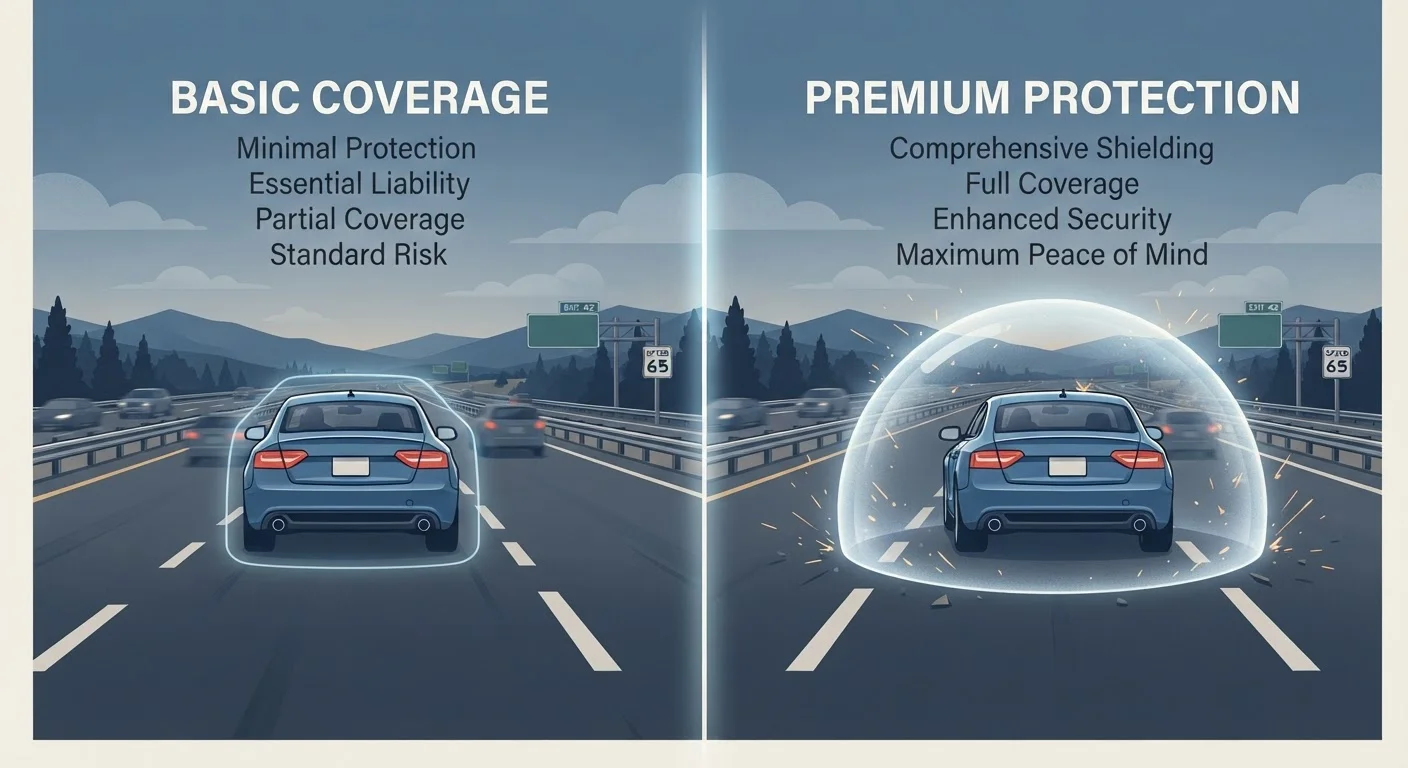
Key Takeaways
Option A
Liability-Only Coverage
The legally required minimum that protects others, not your car.
Best for: Drivers with older, lower-value vehicles who can afford to replace or repair their own car out of pocket.
Option B
Full Coverage
A bundled policy that adds protection for your own vehicle on top of liability.
Best for: Drivers with newer or financed vehicles who need protection against both at-fault accidents and unpredictable events.
If you own an older vehicle outright with low market value
Liability-Only Coverage
When a car's value is low, the added premium cost of collision and comprehensive may exceed what you'd realistically recover in a claim.
If you're financing or leasing your vehicle
Full Coverage
Lenders and leasing companies typically require full coverage to protect the asset securing the loan or lease agreement.
If you drive a newer or high-value vehicle you own outright
Full Coverage
A serious accident or theft could mean a large, unexpected expense; full coverage limits your financial exposure significantly.
If your emergency savings can comfortably cover vehicle repair or replacement
Liability-Only Coverage
Self-insuring your own car may be a rational choice when you have the financial cushion to absorb the loss without hardship.
What Liability Coverage Actually Covers
Every state requires drivers to carry at least a minimum level of auto insurance, and that minimum is almost always liability coverage. Despite being the legal baseline, liability is frequently misunderstood. It does one specific thing: it pays for bodily injury and property damage you cause to other people in an accident where you are at fault.
Liability coverage has two main components. Bodily injury liability covers medical expenses, lost wages, and legal costs for the other driver or passengers you injure. Property damage liability pays to repair or replace the other driver's vehicle or property. What it does not cover is any damage to your own car, or your own medical bills - regardless of fault.
For a fuller picture of how liability fits within the broader policy landscape, see our guide to auto insurance coverage types.
Liability Limits Are Set as Numbers, Not Dollars
You'll typically see liability expressed as three numbers, such as 25/50/25. These represent: $25,000 per injured person, $50,000 per accident for bodily injury, and $25,000 for property damage. State minimums vary, and higher limits provide greater protection if you're sued after a serious accident. Carrying only the state minimum is legal, but it may not be adequate depending on your assets.
What "Full Coverage" Really Means
"Full coverage" is an industry shorthand, not a formal policy term. In practice, it refers to a policy that combines liability with two additional coverage types: collision and comprehensive.
- Collision coverage pays to repair or replace your vehicle after an accident involving another car or object, regardless of fault.
- Comprehensive coverage pays for damage caused by events outside a collision - theft, vandalism, weather, fire, or hitting an animal.
Together, these three layers cover a much wider range of scenarios. It's worth noting that even a "full coverage" policy has limits, deductibles, and exclusions. It is not literally all-inclusive - for instance, mechanical breakdown and normal wear and tear are typically excluded. For a side-by-side breakdown of collision and comprehensive, see our collision vs. comprehensive comparison.
| Criterion | Liability-Only | Full Coverage |
|---|---|---|
| Covers damage you cause to others | Yes | Yes |
| Covers your own vehicle after a collision | No | Yes (collision) |
| Covers theft, weather, or fire | No | Yes (comprehensive) |
| Required by lenders/lessors | No | Typically yes |
| Typical premium cost | Lower | Higher |
| Out-of-pocket risk after an at-fault crash | High (your car) | Limited to deductible |
| Meets state minimum requirements | Yes | Yes |
The Financial Risk Each Option Carries
The core trade-off is straightforward: liability-only costs less in premiums but leaves you fully responsible for your own vehicle's repair or replacement costs. Full coverage costs more each month but limits your out-of-pocket exposure after an accident, theft, or weather event.
A key factor is your vehicle's actual cash value (ACV) - what your car is worth on the open market today, accounting for depreciation. If your car's ACV is low, the maximum payout from a comprehensive or collision claim is also low, which can make the added premium feel like poor value. Understanding how insurers calculate payouts on a totaled vehicle is worth exploring - our article on agreed value vs. actual cash value walks through that distinction clearly.
~13%
Estimated share of U.S. drivers uninsured
According to the Insurance Research Council, roughly one in eight U.S. drivers was uninsured in a recent national estimate.
$5,000+
Average collision claim cost
Industry data from the Insurance Information Institute indicates the average collision insurance claim has historically exceeded several thousand dollars.
One gap worth flagging: neither liability-only nor standard full coverage automatically protects you when the other driver has no insurance or inadequate coverage. That requires a separate add-on. Our piece on uninsured and underinsured motorist coverage covers that gap in detail.
How to Think Through Your Own Decision
There is no single correct answer. The right coverage level depends on several intersecting factors:
- Vehicle value: A rough industry rule of thumb suggests reconsidering full coverage when annual premium costs for collision and comprehensive approach 10% of the car's value - though your financial situation ultimately determines what's sensible.
- Ownership status: If you finance or lease, your lender or lessor generally requires full coverage. See our article on buying vs. leasing for more on how ownership structure shapes your insurance obligations.
- Your financial cushion: Could you replace your car out of pocket if it were totaled tomorrow? If not, full coverage's protection is difficult to justify skipping.
- Deductible choices: Raising your deductible lowers your premium but increases what you pay after a claim. Our guide to deductibles and coverage limits explains these trade-offs in detail.
For a structured framework on sizing your overall coverage, our article on evaluating how much coverage you actually need walks through the key questions. This article is for general informational purposes and does not constitute personalised insurance advice. Coverage terms, exclusions, and requirements vary by state and provider - review your policy documents and consult a licensed insurance agent for guidance specific to your situation.
This article is for informational purposes only and is not personalised insurance or financial advice. Consult a licensed insurance professional for guidance tailored to your circumstances.