

Key Takeaways
Auto Insurance Coverage Types
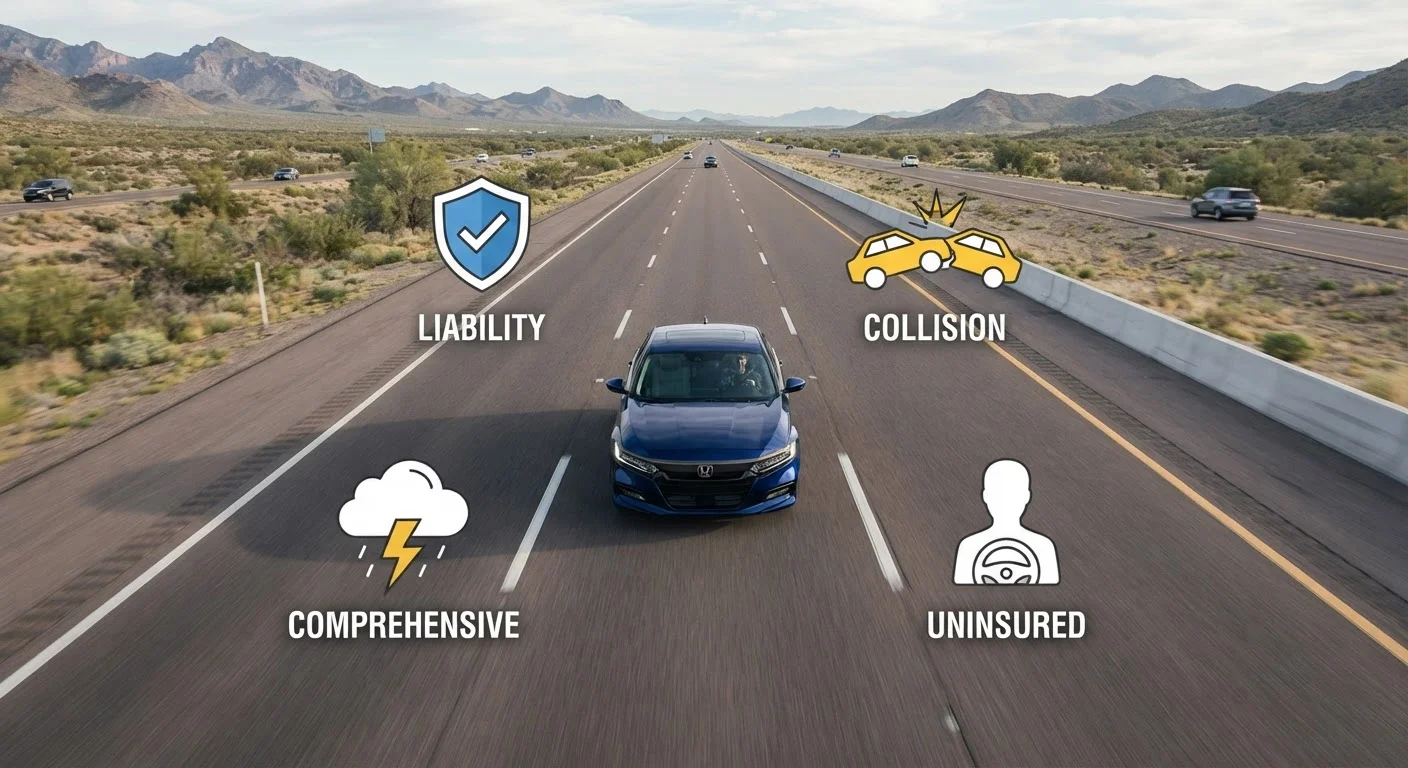
Auto insurance is not a single protection - it is a bundle of distinct coverage types, each designed to address a different kind of financial risk. Liability covers harm you cause to others. Collision covers damage to your own vehicle from an accident. Comprehensive covers non-collision events like theft or weather. Uninsured motorist coverage steps in when the at-fault driver lacks adequate insurance.
Each coverage type carries its own limit (the maximum the insurer will pay) and, in most cases, a deductible (the amount you pay out of pocket before coverage activates). These figures are set when you purchase your policy.
Why Coverage Types Matter
When you purchase an auto insurance policy, you are not buying a single blanket protection - you are selecting a combination of coverage types, each addressing a specific category of risk. Knowing what each type actually does allows you to evaluate whether your policy matches your real-world exposure.
For a broader grounding in auto insurance vocabulary - terms like premium, limit, and exclusion - see our plain-language reference guide before diving into coverage specifics. The Auto Insurance Basics hub is also a useful starting point for first-time policyholders.
~13%
U.S. drivers estimated uninsured
The Insurance Research Council has estimated that roughly 1 in 8 drivers on U.S. roads carries no auto insurance, underscoring the value of uninsured motorist coverage.
49 of 50
States requiring liability insurance
All U.S. states except New Hampshire require some form of liability auto insurance, though minimum required limits vary significantly by state.
2-3x
Cost difference: liability-only vs. full coverage
Adding collision and comprehensive to a liability-only policy typically increases premiums substantially, though the exact amount depends on vehicle value, driver profile, and location.
Liability Coverage: Protecting Others When You Are at Fault
Liability coverage is the foundation of almost every auto policy in the United States - and the only type mandated by law in the vast majority of states. It pays for bodily injury and property damage you cause to other people in an accident where you are at fault. It does not cover your own injuries or your own vehicle.
Policies typically express liability limits in a split format, such as 25/50/25 - meaning $25,000 per injured person, $50,000 per accident for bodily injury, and $25,000 for property damage. If damages exceed those limits, you bear personal financial responsibility for the difference, which is why many financial professionals suggest carrying limits higher than your state's legal minimum.
Consider Limits Above State Minimums
State minimum liability limits are often set at levels that can be quickly exceeded in a serious accident. If damages surpass your limits, you may be personally responsible for the difference. Many insurance professionals suggest evaluating your assets and risk tolerance when choosing liability limits - not just meeting the legal floor.
Collision and Comprehensive: Covering Your Own Vehicle
Where liability looks outward, collision and comprehensive coverages look inward - they pay for damage to your vehicle, subject to your deductible.
Collision coverage applies when your car is damaged in a crash: hitting another vehicle, rolling over, or striking an object like a guardrail. The cause is a physical impact involving your vehicle's movement.
Comprehensive coverage covers losses that are not the result of a collision - theft, fire, hail, flooding, falling objects, or animal strikes. Think of it as covering events largely outside your control.
These two coverages are closely related but cover different situations. A side-by-side breakdown of collision vs. comprehensive can help clarify which applies to a specific type of damage.
Uninsured and Underinsured Motorist Coverage
Uninsured motorist (UM) coverage protects you when a driver who hits you has no insurance at all. Underinsured motorist (UIM) coverage applies when the at-fault driver has insurance, but their limits are too low to fully cover your damages. Both are often sold together as a paired coverage.
This protection extends to bodily injury and, in some states, property damage. It can also apply in hit-and-run situations. Despite the real risk it addresses, many drivers either skip it or are unaware they have it. Learn more about how UM/UIM coverage works and when it typically applies.
UM/UIM Requirements Vary by State
Some states require insurers to offer uninsured and underinsured motorist coverage, and some require drivers to carry it. In others, it is entirely optional. Even where optional, policyholders may need to decline it in writing. Check your state's requirements and review your policy documents carefully to understand what you do and do not have.
Putting It Together: Building a Policy That Fits
Most drivers carry a combination of the coverage types above. A basic policy might include only state-minimum liability. A more comprehensive policy adds collision and comprehensive - what is informally called "full coverage" - plus UM/UIM protection.
The right combination depends on factors like your vehicle's current value, your savings and assets, your state's requirements, and how you use your car. Evaluating how much coverage you actually need walks through those questions in practical terms. For a clear explanation of the difference between liability-only and full-coverage policies, see liability vs. full coverage explained.
This article provides general information about auto insurance coverage types for educational purposes only. Coverage terms, limits, exclusions, and availability vary by insurer and by state. Consult a licensed insurance professional for guidance specific to your situation.
“Auto insurance is not a commodity where you simply choose the lowest price. Understanding what each coverage type actually does - and what it leaves out - is the only way to know whether you are genuinely protected.”
— Insurance Consumer Education Alliance, Non-profit organization focused on consumer insurance literacy