

Key Takeaways
Our Verdict
Zone-based ownership tends to work best for adults sharing a home long-term because it minimizes daily decision-making. Rotating chore charts shine in households with children who are building responsibility habits. Task-based division by preference is most effective when housemates have genuinely different strengths and availability. Most resilient households ultimately blend two or more approaches.
| Best for | Recommended |
|---|---|
| Couples or adult housemates wanting minimal daily negotiation | Zone-Based Ownership |
| Families with school-age children learning responsibility | Rotating Chore Chart |
| Housemates with varied schedules and different skill sets | Task-Based Division by Preference |
| Larger households needing flexible, scalable structure | Hybrid System |
Why Chore Systems Break Down
Most households don't fail at chores because people are lazy - they fail because the system (or absence of one) creates ambiguity. When nobody knows who is responsible for a task, it either goes undone or one person silently absorbs it. Over time, that imbalance erodes goodwill and creates friction that spills into other areas of shared life.
Research on household labor consistently shows that unequal distribution of domestic work is a common source of relationship stress - not just in romantic partnerships, but among roommates and family members too. The solution isn't motivation; it's structure. A well-chosen system removes the guesswork and replaces ongoing negotiation with agreed-upon defaults. For households also working to align around shared finances, the same logic applies - see budgeting as a household for parallel strategies.
Below, we compare four common approaches to help you identify which fits your household's size, schedule, and dynamics.
Four Approaches Compared
Each system below has a different core logic. Understanding that logic helps you predict whether it will hold up in your household - or collapse under real-life pressure.
| Zone-Based Ownership | Rotating Chore Chart | Task-Based by Preference | Hybrid System | |
|---|---|---|---|---|
| Daily decision-making required | Very low | Low (follow the chart) | Low once established | Low to moderate |
| Fairness across household members | Depends on zone assignment | High - everyone rotates equally | Subjective, needs agreement | High with good design |
| Works well with children | Moderate | Excellent | Less effective | Excellent |
| Adapts to schedule changes | Challenging | Moderate | Moderate | Most flexible |
| Setup effort required | Low | Moderate | Moderate | Higher upfront |
| Risk of resentment over time | Moderate if unequal zones | Low | Moderate if invisible tasks | Low with regular reviews |
The sections that follow break down the practical realities of each approach, including where they tend to succeed and where they commonly unravel.
Zone-Based Ownership and Rotating Charts
Zone-Based Ownership
In this model, each person takes full, ongoing responsibility for one or more defined areas of the home. One adult owns the kitchen - wiping counters, loading the dishwasher, restocking pantry staples. Another owns the bathrooms. A third owns vacuuming common spaces. Ownership is consistent week to week.
The main advantage is that it eliminates the recurring decision of who does what. Each person develops efficient habits for their zone and sets their own timing. The downside is that zones are rarely equal in effort, so upfront negotiation about zone assignment matters. It also works less well when household members travel frequently or have dramatically shifting schedules.
Negotiate Zone Assignments Before You Finalize
Before locking in zone ownership, list every task within each zone and estimate the weekly time each requires. If one zone takes substantially longer than another, consider splitting a large zone or adding a compensating task to another person's plate. The goal is perceived fairness, not just a clean map on paper.
Rotating Chore Charts
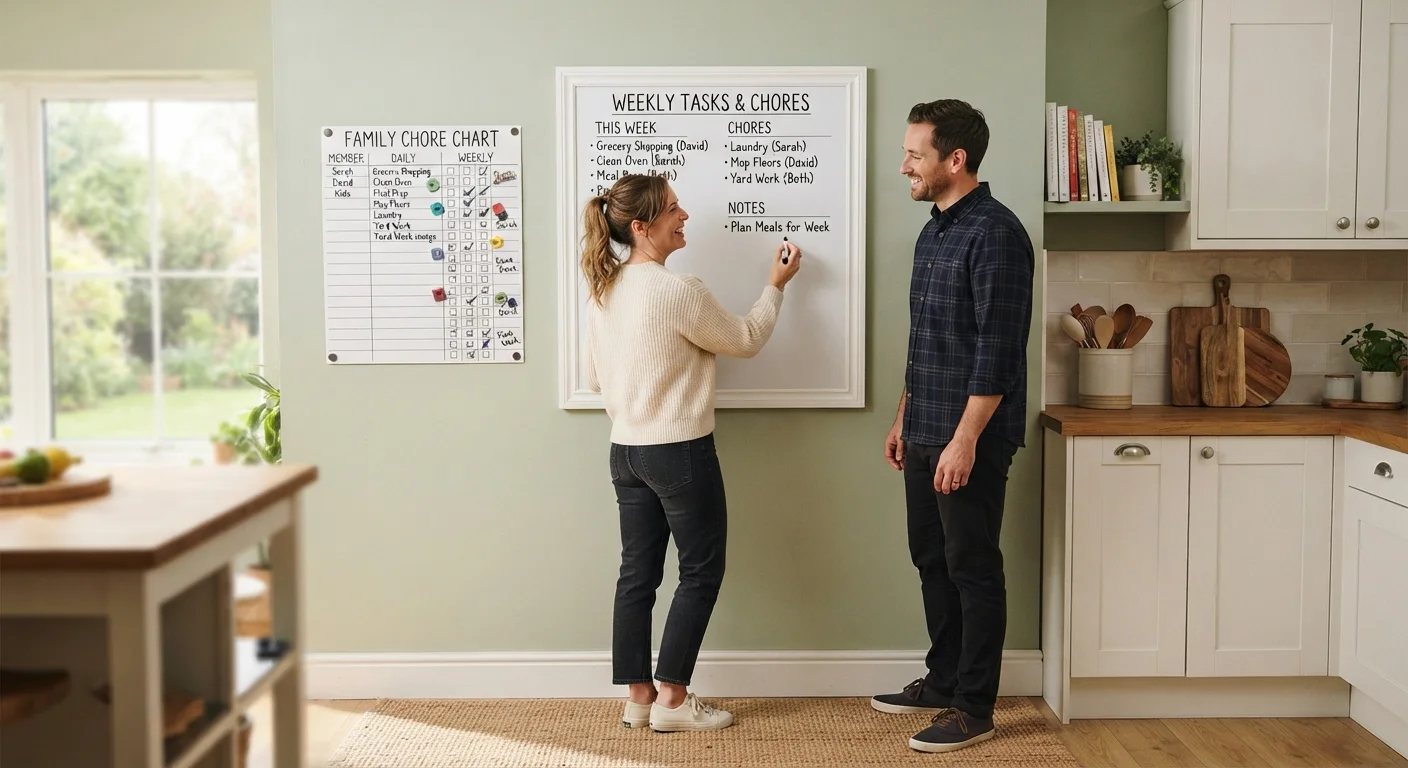
Here, a list of recurring tasks is assigned on a weekly or biweekly rotation so that everyone takes turns with every chore, including the least desirable ones. This is particularly popular in households with children, where the educational value of doing a variety of tasks is part of the point. For guidance on age-appropriate task assignments, getting children involved in home responsibilities offers a useful framework.
The main challenge is consistency - rotating systems require everyone to check the chart and follow through. Without a shared reminder or brief weekly reset, the chart becomes decoration. Pairing it with a shared household calendar can help.
Task-Based Division and Hybrid Systems
Task-Based Division by Preference or Skill
Rather than dividing space or rotating equally, this approach assigns tasks based on who genuinely does them better, faster, or minds them least. One person handles all cooking because they enjoy it; the other takes all outdoor maintenance. Division isn't equal in task count - it's balanced in perceived effort and willingness.
This works well for households where strengths differ meaningfully. The risk is that it can entrench patterns that later feel unfair, especially if one person's tasks are invisible (like administrative household management) while the other's are obvious (like mowing). Building in periodic reviews helps prevent this drift. Reducing invisible decision-making is also addressed in running a home on autopilot.
Hybrid Systems
Many stable households combine approaches: zone ownership for daily upkeep, rotating charts for deep-cleaning tasks, and preference-based assignments for specialized work. The weekly reset routine concept fits naturally into a hybrid model, where zone owners handle their spaces during a shared weekly window.
65%
Adults reporting household chores cause relationship conflict
According to survey data from the American Family Survey, disagreements over household responsibilities rank among the most common sources of domestic tension for U.S. couples.
~2 hrs
Average daily household work per adult
The U.S. Bureau of Labor Statistics American Time Use Survey consistently finds adults spend roughly two hours per day on household activities, though distribution varies significantly by household role.
Whatever system you choose, schedule a brief monthly check-in - 10 to 15 minutes - to assess whether the current split still reflects everyone's actual capacity. Life changes: jobs shift, health changes, new people join the household. A system that doesn't adapt will eventually collapse.