

Key Takeaways
Reduces scheduling conflicts and double-bookings
When all household commitments are visible in one place, overlapping obligations are caught before they cause problems - particularly useful for households sharing one car or managing shared childcare pickups.
Distributes scheduling mental load more evenly
A visible shared system means household members can check schedules independently, reducing the burden on one person to field constant 'what's happening this weekend?' questions.
Integrates reminders for recurring household tasks
Bill due dates, filter changes, seasonal maintenance, and subscription renewals can be anchored to a calendar, making it harder to let time-sensitive tasks slip through unnoticed.
Syncs across devices in real time
Changes made from one person's phone are visible immediately to others - no lag, no need to text updates, and no version-control issues with printed or handwritten schedules.
Scalable for households of any size
Whether the household has two adults or two adults and three children, most calendar apps allow unlimited members and color-coded layers without added cost or complexity.
Uneven adoption undermines reliability quickly
If some household members update the calendar consistently and others don't, it becomes an unreliable source of truth - which can actually increase conflict by creating false confidence in the schedule.
Privacy may feel compromised for some members
Adult housemates or partners who value autonomy may be uncomfortable with all personal appointments being visible to others; a fully merged calendar without personal layers can feel intrusive.
Requires ongoing maintenance to stay accurate
Unlike a static document, a calendar only works if it's actively updated. Households that fall behind on entries may find it more misleading than helpful.
Platform dependency creates migration risk
Building a household coordination system around a single app means a change in that app's pricing, features, or availability can disrupt an ingrained routine.
Can become one person's sole responsibility
In practice, shared calendars often drift toward being managed by one household member, which recreates the mental load imbalance the system was meant to address.
Our Verdict
Shared household calendars deliver real coordination benefits for busy multi-person homes, but they require buy-in from everyone involved to function well. When adoption is uneven or the system becomes one person's burden, the calendar creates more friction than it resolves. Used thoughtfully alongside personal calendars, a shared system is a practical household management tool - not a magic fix.
Households with two or more adults managing overlapping commitments - especially families with children, school schedules, or shared caregiving responsibilities.
What a Shared Household Calendar Actually Is
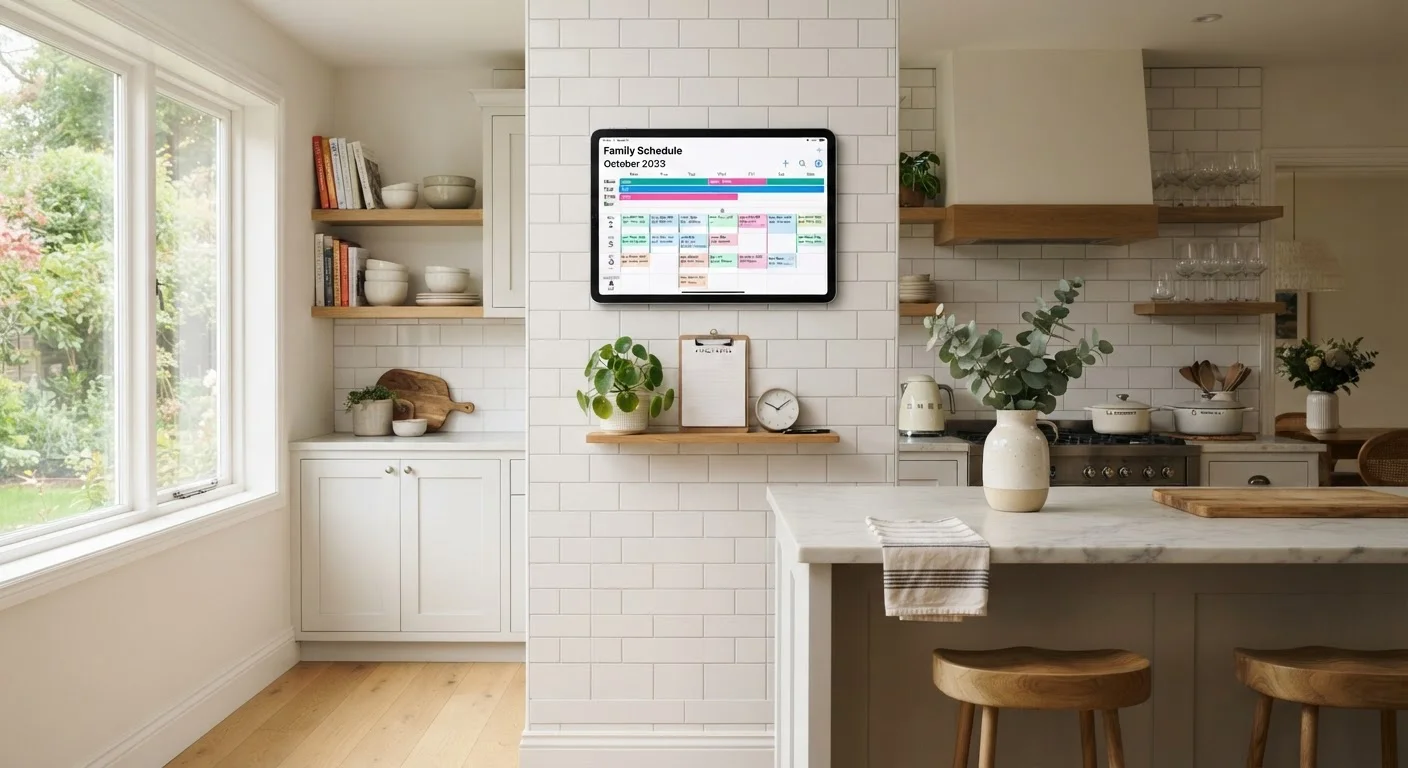
A shared household calendar is a single scheduling system - usually a digital app like Google Calendar, Apple Calendar, or a dedicated family app - where every member of a household can view and add events. The goal is simple: replace the scattered combination of individual phone calendars, sticky notes, and verbal reminders with one visible, central record of what's happening and when.
These systems can track school pickups, bill due dates, social commitments, maintenance appointments, recurring chores, and seasonal tasks. Some households integrate them with where time and money quietly disappear by using the calendar to flag subscription renewals or service appointments before they're forgotten.
Most digital calendar tools allow color-coding by person or category, push notifications, and cross-device syncing - which is part of why they've become a default tool for many households. But convenience and actual usefulness are different things.
The Case For: Real Coordination Benefits
Reduces scheduling conflicts and double-bookings
When all household commitments are visible in one place, overlapping obligations are caught before they cause problems - particularly useful for households sharing one car or managing shared childcare pickups.
Distributes scheduling mental load more evenly
A visible shared system means household members can check schedules independently, reducing the burden on one person to field constant 'what's happening this weekend?' questions.
Integrates reminders for recurring household tasks
Bill due dates, filter changes, seasonal maintenance, and subscription renewals can be anchored to a calendar, making it harder to let time-sensitive tasks slip through unnoticed.
Syncs across devices in real time
Changes made from one person's phone are visible immediately to others - no lag, no need to text updates, and no version-control issues with printed or handwritten schedules.
Scalable for households of any size
Whether the household has two adults or two adults and three children, most calendar apps allow unlimited members and color-coded layers without added cost or complexity.
The strongest argument for a shared calendar is reduced coordination overhead. In households where two adults manage work schedules, childcare, and home maintenance, a shared view prevents the classic collision - two people booking conflicting obligations or one person being blindsided by a commitment the other forgot to mention.
Shared calendars also distribute mental load more evenly. When one person traditionally holds all scheduling information in their head, a visible system means others can check availability and context independently rather than asking. This pairs well with other household systems - for instance, when dividing household chores, attaching tasks to specific dates makes ownership clearer.
For families managing school calendars, medical appointments, or seasonal home tasks like those described in a seasonal home transitions guide, a shared calendar provides a persistent reminder system that individual memory simply can't replicate reliably.
The Case Against: Where Shared Calendars Break Down
Uneven adoption undermines reliability quickly
If some household members update the calendar consistently and others don't, it becomes an unreliable source of truth - which can actually increase conflict by creating false confidence in the schedule.
Privacy may feel compromised for some members
Adult housemates or partners who value autonomy may be uncomfortable with all personal appointments being visible to others; a fully merged calendar without personal layers can feel intrusive.
Requires ongoing maintenance to stay accurate
Unlike a static document, a calendar only works if it's actively updated. Households that fall behind on entries may find it more misleading than helpful.
Platform dependency creates migration risk
Building a household coordination system around a single app means a change in that app's pricing, features, or availability can disrupt an ingrained routine.
Can become one person's sole responsibility
In practice, shared calendars often drift toward being managed by one household member, which recreates the mental load imbalance the system was meant to address.
The most common failure mode is uneven adoption. If one person diligently updates the calendar while others treat it as optional, the system becomes unreliable - and the person maintaining it often ends up more frustrated than if no shared system existed at all.
There's also the question of privacy. Household members may not want every personal appointment, medical visit, or social engagement visible to others. A fully shared calendar with no personal-calendar boundary can feel intrusive, especially among adult housemates who aren't partners.
Personal vs. Shared: A Practical Boundary
Most calendar apps let you maintain separate personal and shared calendars simultaneously, choosing which events appear in each. Setting this up takes only a few minutes and preserves individual privacy while keeping household-relevant events visible to everyone. This layered approach is generally more sustainable than a single fully-merged household calendar, especially in households where members have distinct personal and professional lives.
Digital calendar systems also introduce platform dependency. If a household builds its entire coordination around one app and that app changes its pricing, policies, or availability, migrating the system takes real effort - particularly when recurring events and years of history are involved. The same concern applies to any digital-only household management approach, as explored in the comparison of paper versus digital household document management.
Who Benefits Most - and Who Might Not
~70%
U.S. adults using smartphones for scheduling
Pew Research Center data consistently shows that the majority of U.S. adults rely on smartphones as their primary personal organization tool, making digital calendar adoption a natural extension.
1 in 3
Households reporting scheduling conflicts weekly
Survey data from household management researchers suggests that scheduling conflicts - missed pickups, double-booked commitments - are a frequent source of household friction for roughly a third of multi-person homes.
Shared calendars tend to provide the most value in households with high scheduling complexity: two working adults, children with school and activity schedules, shared caregiving responsibilities, or frequent overlapping commitments. The coordination payoff is proportional to how often schedules intersect.
Households with simpler routines - or where members have very independent schedules with minimal overlap - may find that a shared calendar adds maintenance work without solving a real problem. Similarly, households where financial coordination is already strained, such as those working through the challenges covered in budgeting as a household, may find that calendar adoption requires a conversation about shared systems more broadly before it works.
The tool works best as a complement to individual scheduling habits, not a replacement. A practical middle ground: maintain personal calendars for individual commitments and a shared calendar only for events affecting the whole household.
Making the System Actually Work
If you decide to implement a shared household calendar, a few practical habits improve the odds of it sticking. First, agree on what belongs on the shared calendar and what stays personal - a brief household conversation about this prevents resentment later. Second, set a consistent update habit: many households find that a brief weekly check-in, even just five minutes, keeps the calendar accurate and surfaces conflicts before they become problems.
Use color-coding or separate calendar layers to distinguish between individuals and categories (work, school, home maintenance, health). Most calendar apps support this without requiring any technical setup. Notifications should be configured individually - one person's preference for 10-minute reminders shouldn't override another's preference for none at all.
Finally, revisit the system every few months. Household schedules change with seasons, life stages, and routine shifts. A system that worked well in one period may need adjusting - and that's normal. The goal isn't calendar perfection; it's a coordination tool that reduces friction more than it creates it.