

Key Takeaways
Our Verdict
Both methods can produce meaningful results when used consistently. Manual tracking tends to deepen engagement with spending behavior, while apps reduce friction and surface patterns automatically. The best choice depends on your privacy comfort level, available time, and what kind of accountability actually motivates you.
| Best for | Recommended |
|---|---|
| Those who want deeper behavioral awareness and no app access to accounts | Manual tracking |
| Busy households managing many transactions across multiple accounts | App-based tracking |
| Anyone who has tried one method and repeatedly abandoned it | Hybrid approach |
Why the Tracking Method Matters
Budgeting advice often skips straight to categories and percentages - but the method you use to record spending shapes whether the habit sticks at all. A tracking system that feels burdensome gets abandoned. One that fits your routine actually changes behavior.
The core question isn't which tool is technically superior. It's which one keeps you engaged long enough to notice patterns, adjust habits, and build financial momentum. This comparison lays out the honest trade-offs so you can make a clear-eyed choice.
If your household already struggles to keep track of recurring costs, you may find useful context in where households commonly lose track of spending - it highlights the specific blind spots that catch most budgets off guard.
Manual Tracking: Strengths and Limitations
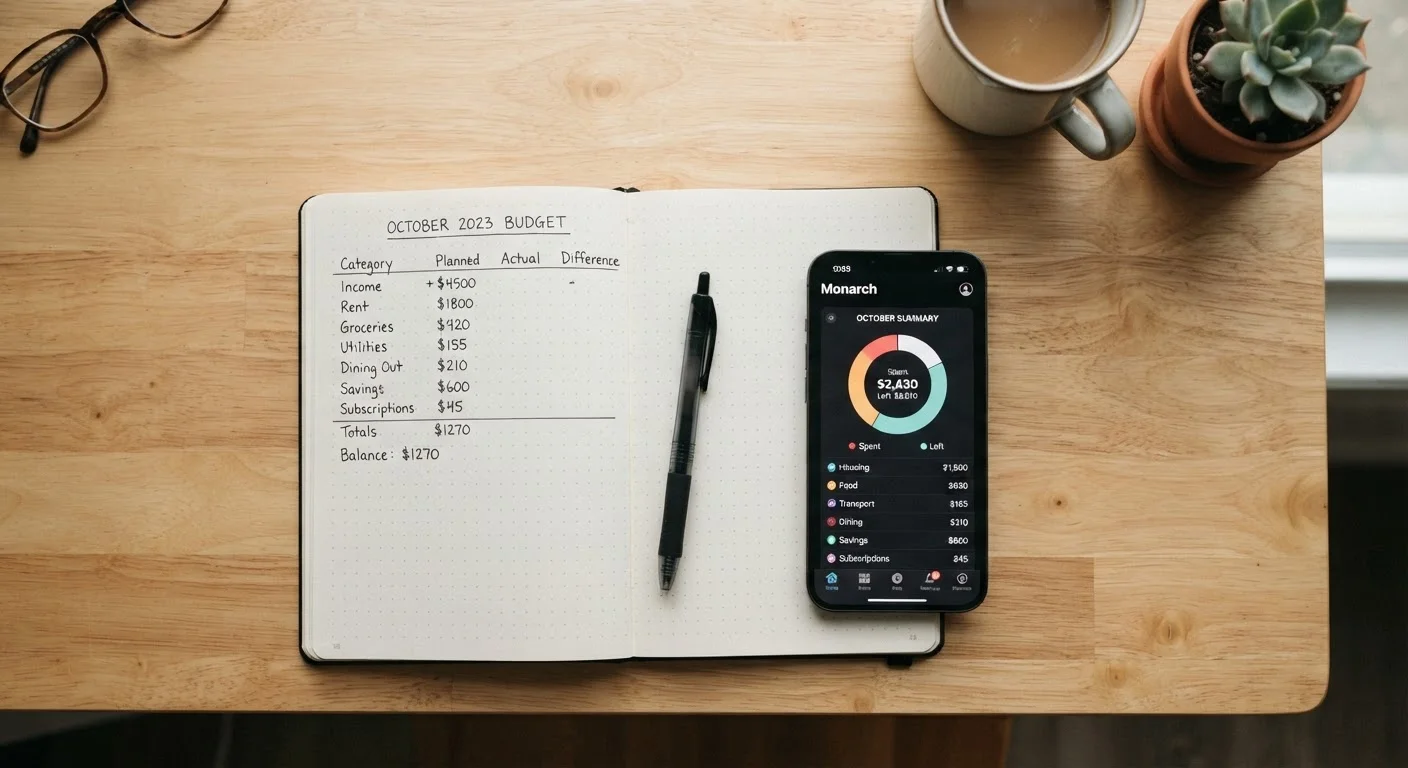
Writing down every purchase by hand - in a notebook, a printed spreadsheet, or a simple ledger - is the original budgeting method. Its primary advantage is psychological: the physical act of recording a transaction makes it harder to ignore. Research in behavioral economics consistently finds that friction, when applied at the point of spending review, increases awareness and can reduce impulsive purchases over time.
Manual tracking also carries zero privacy risk tied to financial data sharing. You're not connecting a bank account to any third-party platform, which matters to consumers who are cautious about how their financial information is used.
The limitations are real, though. Manual entry is time-intensive. Miss a few days and the system collapses. Cash transactions are easy to forget. And if you're managing multiple accounts or a high transaction volume, the workload quickly becomes impractical.
Try Manual Tracking for One Month First
If you've never tracked spending before, starting with a notebook for 30 days can build foundational awareness before you automate anything. You'll learn which categories genuinely surprise you - and those insights make app setup more intentional. Many people find this sequence more effective than jumping straight to an app.
Who it suits best: People who are motivated by ritual and reflection, have relatively simple finances, prefer pen-and-paper systems, or have privacy concerns about linking bank credentials to an app.
App-Based Tracking: Strengths and Limitations
Budgeting and expense-tracking apps automate the tedious part: pulling in transactions from connected bank accounts and credit cards, then categorizing them. The practical result is a near-complete picture of your spending with minimal daily effort on your part.
Apps also surface trends that are difficult to see by hand - month-over-month comparisons, category breakdowns, and subscription spending. For households managing multiple accounts or income streams, this visibility is genuinely hard to replicate manually.
The trade-offs center on privacy and security. Most full-featured budgeting apps require you to provide your banking credentials or connect through a data aggregator service. Before linking any account, it's worth understanding what permissions the app requests and how your data may be used or stored. Our overview of app permissions you should review explains what common access requests actually mean in practice.
Understand What App Access Actually Means
Many budgeting apps connect to your accounts through third-party data aggregators, which may store your credentials or transaction history on their own servers. Before linking an account, read the app's privacy policy and understand your options if you want to revoke access later. Using a dedicated, strong password for any linked financial account is a minimum precaution.
Who it suits best: People with complex finances, high transaction volume, or limited time - and who are comfortable with the data-sharing requirements involved in account linking.
How the Two Approaches Stack Up
Here's a direct comparison across the factors that matter most for everyday use:
| Manual Tracking | App-Based Tracking | |
|---|---|---|
| Setup effort | Minimal - just paper and a pen | Moderate - account linking required |
| Daily time commitment | 5-15 minutes of manual entry | Low once connected; mainly review time |
| Accuracy | Depends on consistent entry | High if accounts are fully linked |
| Privacy exposure | None - no data shared externally | Requires sharing bank credentials or tokens |
| Behavioral awareness | High - writing reinforces mindfulness | Moderate - easy to ignore automated data |
| Best for complex finances | Challenging at high volume | Well-suited to multiple accounts |
No single dimension determines the right choice. If you value depth of reflection over convenience, manual tracking may outperform any app. If you need automated visibility across several accounts, apps close a gap that pen-and-paper simply can't.
An analogy: choosing between these two methods is not unlike choosing a navigation approach for a road trip - paper maps demand more engagement but don't rely on connectivity or data sharing, while live apps do the heavy lifting but require trust in the platform.
Building a Habit That Lasts
The most effective tracking method is the one you actually use consistently. A few practical considerations:
- Start simple. Tracking every category from day one often leads to burnout. Begin with two or three spending areas that feel unclear or out of control.
- Pick a review cadence. Weekly is manageable for most people. Daily is too granular; monthly is too infrequent to course-correct.
- Combine if it helps. Some people use an app to collect raw data and a notebook for weekly reflection - getting the automation benefit without losing the mindfulness aspect.
- Protect your data. If using an app, review its privacy policy, understand how credentials are stored, and use strong, unique passwords for connected accounts.
Whichever approach you choose, the goal is the same: replace vague anxiety about money with clear, actionable information. That shift - from guessing to knowing - is where lasting financial progress begins.
This article is for general informational and educational purposes only and does not constitute personalized financial advice. For guidance specific to your situation, consider consulting a qualified financial professional.