

Key Takeaways
Understanding the Types of Debt
Debt falls into two broad categories: secured and unsecured. Secured debt is backed by collateral - a home for a mortgage, a vehicle for an auto loan. If you stop paying, the lender can seize that asset. Unsecured debt, such as credit cards and medical bills, carries no collateral, which is why lenders typically charge higher interest rates to offset their risk.
Within those categories, debt also behaves differently based on its structure:
- Revolving debt (credit cards, lines of credit): You borrow up to a limit repeatedly, and your minimum payment fluctuates with your balance.
- Installment debt (mortgages, student loans, auto loans): Fixed payments over a set term until the balance reaches zero.
- Payday and high-cost loans: Short-term borrowing with extremely high APRs - often 300% or more - that can trap borrowers in a cycle of re-borrowing.
Understanding where your debt fits helps you prioritize. High-interest unsecured debt typically costs you the most money over time and deserves the most aggressive repayment focus. For a quick-reference glossary of the terms you'll encounter, see Credit Terminology You'll Encounter at Every Financial Milestone.
Federal vs. Private Student Loans Differ Significantly
Federal student loans carry income-driven repayment options, deferment programs, and potential forgiveness pathways that private student loans do not. If student debt is part of your picture, understand which type you hold before choosing a repayment approach - the optimal strategy can differ substantially.
How Debt Affects Your Credit Score
Your credit score is a three-digit number - typically ranging from 300 to 850 - that signals to lenders how reliably you repay what you borrow. Two factors dominate the calculation under widely used scoring models:
- Payment history (~35%): Whether you pay on time. Even one missed payment can meaningfully lower your score.
- Credit utilization (~30%): The percentage of your available revolving credit you're using. Carrying a balance above roughly 30% of your credit limit tends to drag your score down.
Other factors - length of credit history, credit mix, and new inquiries - matter too, but to a lesser degree. The practical implication: paying down credit card balances and never missing a due date are the two highest-leverage moves available to most people.
$1.13T
Total U.S. credit card debt outstanding
According to the Federal Reserve Bank of New York's Q4 2023 Household Debt and Credit Report.
~30%
Credit utilization threshold to protect your score
Most credit scoring experts advise keeping revolving utilization below 30% of available limits.
7 years
How long a collections account stays on your credit report
Under the Fair Credit Reporting Act, most negative marks - including collections - can remain for up to seven years.
Debt that goes unpaid long enough can result in a charge-off (the lender writes it off as a loss) or be sold to a collections agency. Either event creates a serious negative mark that can remain on your credit report for up to seven years.
Choosing a Repayment Strategy
Two strategies dominate personal finance advice, and both are valid - the right one depends on your psychology as much as the math.
- Avalanche method: Pay minimums on all debts, then throw every extra dollar at the highest-interest balance first. Mathematically optimal - you pay less in total interest.
- Snowball method: Pay off the smallest balance first regardless of rate. Each paid-off account creates a psychological win that sustains momentum.
Research suggests people who need early motivation to stay committed often stick with the snowball method longer, even if it costs slightly more in interest. For a side-by-side breakdown of cost, timeline, and which profile suits each approach, see our Debt Payoff Showdown: Avalanche vs. Snowball.
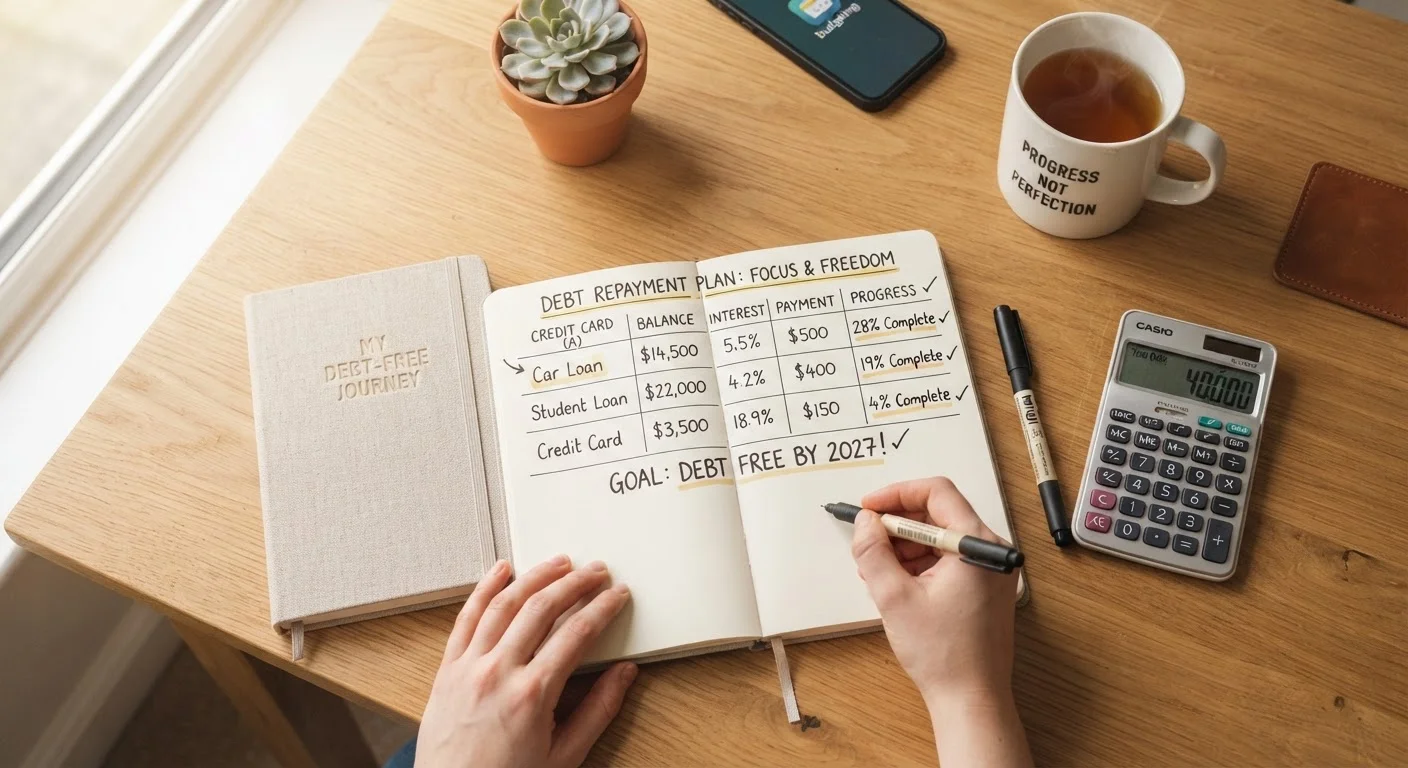
Before committing to either the avalanche or snowball method, write down all your balances and rates on paper. Seeing the full picture often makes the right choice obvious for your specific situation.
Practitioners find that borrowers who map their debts visually are more likely to stay consistent because they have a tangible target rather than an abstract goal.
Set up autopay for at least the minimum on every account - then manually pay extra toward your target debt. This eliminates the single biggest credit score risk: an accidental missed payment.
Payment history is the largest single factor in most credit scoring models, and a single 30-day late mark can cost tens of points.
If your rates are relatively similar, the snowball method's motivational edge may outweigh the marginal interest savings of the avalanche. If you have one or two debts with dramatically higher rates, the avalanche is almost always the smarter financial choice.
Budgeting Around Debt Payments
No repayment strategy works without cash to fund it. The foundational step is building a budget that treats debt payments - at least the minimums - as non-negotiable fixed expenses, the same as rent or utilities.
A common framework is the 50/30/20 rule: roughly 50% of take-home pay toward needs, 30% toward wants, and 20% toward savings and debt repayment. If your debt load is significant, you may need to temporarily tilt that 20% heavily toward repayment and scale back discretionary spending.
Practical starting points:
- List every debt with its balance, minimum payment, and interest rate.
- Identify recurring expenses you can reduce - subscriptions, dining out, streaming services.
- Apply any freed-up cash directly to your target debt each month.
For structured guidance on tracking spending and building a monthly budget, visit our Budgeting Basics hub.
Make Extra Payments Mid-Month
You don't have to wait for your statement due date to make a payment. Sending an extra payment mid-cycle reduces your average daily balance, which directly lowers the interest you're charged that month. Even small extra payments compound meaningfully over time.
When to Seek Professional Help
If your debt feels unmanageable - you're missing payments, receiving collection calls, or only able to make minimums - it's time to explore professional options. Two common paths are debt management plans (DMPs) and debt settlement.
Nonprofit credit counseling agencies can set up a DMP, negotiating lower interest rates with creditors and consolidating your payments into one monthly amount. This approach generally does less damage to your credit than settlement. Fees are typically low or waived for those who qualify.
Debt settlement involves negotiating with creditors to accept less than the full balance. It can reduce your total debt, but it typically causes significant credit score damage and may result in taxable income on the forgiven amount. For-profit settlement companies also charge substantial fees.
For a clear comparison of both paths - including costs, risks, and credit consequences - read our Debt Management Plans vs. Debt Settlement guide.
Beware of Credit Repair Scams
No company can legally remove accurate negative information from your credit report before its natural expiration date. If an organization promises to 'erase' bad credit quickly or asks you to dispute accurate information, that's a red flag. You can dispute genuine errors on your credit report for free directly through the three major credit bureaus.
If you're considering bankruptcy, consult a licensed bankruptcy attorney. Bankruptcy has lasting credit implications but can provide a legal fresh start in cases of severe, unresolvable debt.
This article is for general informational purposes only and is not personalized financial, legal, or tax advice. Consult a licensed financial adviser or attorney for guidance specific to your situation.
Debt and Your Mental Health
Financial stress has well-documented links to anxiety, sleep disruption, and strained relationships. Acknowledging that connection isn't a detour from solving your debt - it's part of the process. Chronic stress can impair the decision-making you need to manage money well, creating a feedback loop that's hard to break alone.
Practical steps to protect your mental health during debt repayment:
- Limit how often you check balances to scheduled times rather than compulsively.
- Celebrate incremental milestones - a paid-off card, a credit score improvement.
- Talk to someone you trust, or seek support from a financial therapist or counselor.
If debt-related stress is affecting your day-to-day functioning, speaking with a mental health professional is a legitimate and valuable step. Our Mental Wellbeing hub offers strategies for managing stress and emotional health, and our overview of Therapy, Counseling, and Psychiatry can help you identify the right kind of support.
This content is for general educational purposes. For personalized mental health support, please speak with a qualified healthcare professional.