

| Ingredient Order Rule | Listed by pre-cooking weight, heaviest first (AAFCO Official Publication) |
| Regulating Body | AAFCO model regulations, enforced at the state level (AAFCO.org) |
| Life Stage Claims | Must be backed by AAFCO nutrient profiles or feeding trials (AAFCO Official Publication) |
| Required Label Panels | Product name, species, net weight, manufacturer info, guaranteed analysis, ingredients, nutritional adequacy statement, feeding directions (FDA Center for Veterinary Medicine) |
| Moisture — Dry Kibble | Typically ≤12% (FDA pet food labeling guidance) |
| Moisture — Canned/Wet Food | Often 75–85% (FDA pet food labeling guidance) |
How Ingredients Are Ordered — and Why It's Not the Whole Story
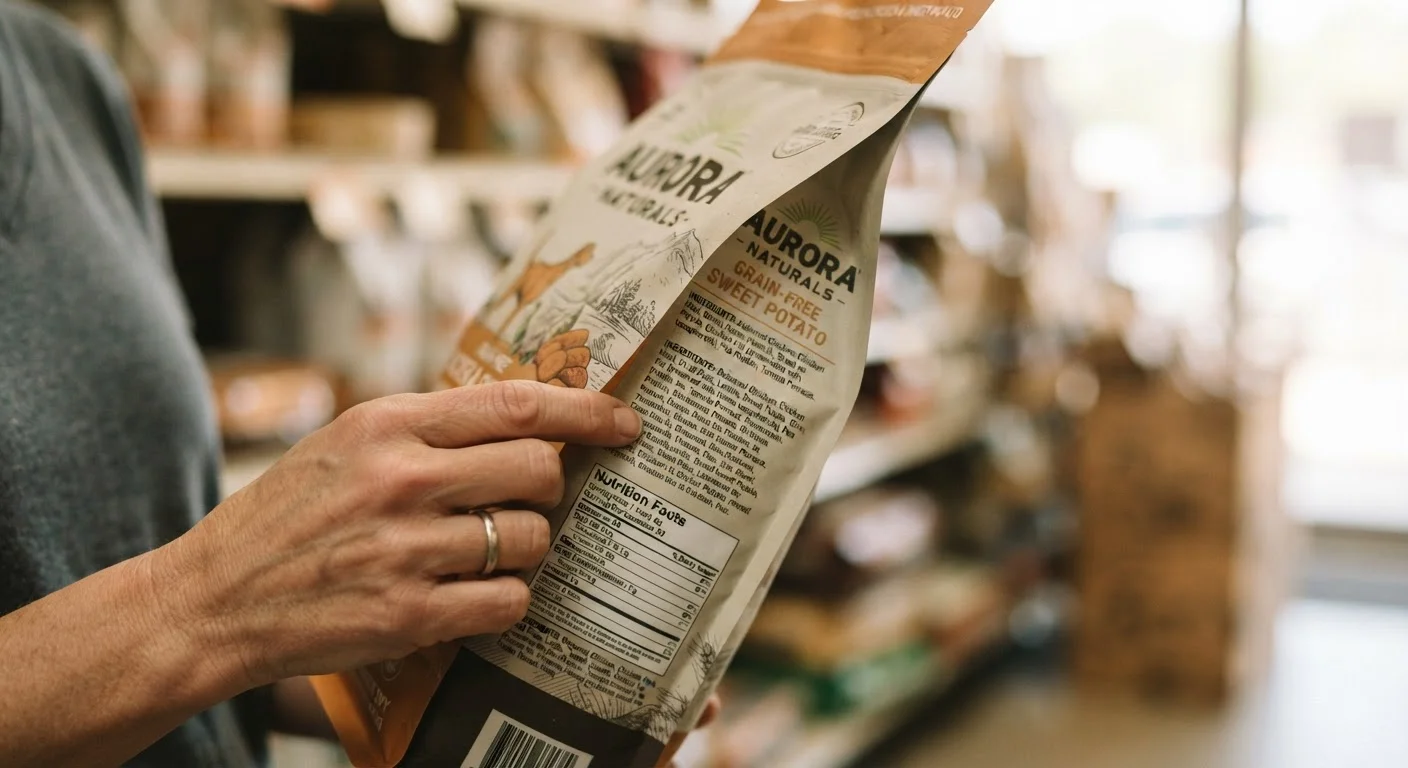
Pet food manufacturers are required to list ingredients in descending order by pre-cooking weight. That means the first ingredient weighed the most before processing — but weight and nutritional contribution are not the same thing. A fresh chicken listed first may be roughly 70% water; once cooked down, it represents far less of the final product than its top position implies.
This is where ingredient splitting becomes relevant. If a manufacturer separates one ingredient — say, corn — into several sub-components such as ground corn, corn gluten meal, and corn bran, each appears separately and lower on the list. Collectively, corn may still be the dominant ingredient. Reading the full list rather than just the first three entries gives you a more accurate picture of what the food is primarily made of.
AAFCO
The Association of American Feed Control Officials. A non-governmental body that establishes model nutrient profiles and labeling standards that many U.S. states adopt into law for pet food regulation.
Guaranteed Analysis
A panel on pet food labels listing minimum or maximum percentages of key nutrients — typically crude protein, crude fat, crude fiber, and moisture. It shows nutrient floors and ceilings, not precise amounts.
Ingredient Splitting
A labeling practice in which one ingredient is listed as multiple sub-forms (e.g., 'ground corn,' 'corn gluten meal,' 'corn bran') to distribute its total weight and push it lower on the ingredient list.
Complete and Balanced
A regulatory phrase indicating a food meets AAFCO nutrient profiles for a stated life stage, either through formulation or feeding trials. Foods without this statement are intended as supplements or treats only.
By-Product
Parts of an animal other than skeletal muscle — including organs, bone, and other tissues. By-products are not inherently low quality; organ meats, for instance, can be nutrient-dense.
Dry Matter Basis
A method of comparing nutrients across foods with different moisture levels by mathematically removing water from the calculation. Essential for fair comparisons between wet and dry foods.
Decoding the Guaranteed Analysis Panel
The guaranteed analysis panel lists minimums for crude protein and crude fat, and maximums for crude fiber and moisture. These are regulatory thresholds, not precise measurements — actual nutrient levels may differ. 'Crude' refers to the laboratory method used to estimate the nutrient category, not its quality or digestibility.
Wet vs. Dry: Nutrient Comparisons Need Adjustment
Because canned food can be 75–85% water, its guaranteed analysis figures look very different from kibble on a percentage basis. To make a fair comparison, convert both to a dry matter basis by dividing each nutrient percentage by (100 minus the moisture percentage), then multiplying by 100. Our guide to dry and wet food formats covers how each delivery format affects nutrition more broadly.
One figure the panel doesn't include is digestibility — how much of a listed nutrient the animal's body can actually absorb and use. Digestibility data exists in published research but is not required on labels. A licensed veterinarian or board-certified veterinary nutritionist can help interpret what guaranteed analysis figures mean for your specific animal's health profile. The Pet Health hub is a useful starting point for broader wellness context.
| Ingredient Order Rule | Listed by pre-cooking weight, heaviest first (AAFCO Official Publication) |
| Regulating Body | AAFCO model regulations, enforced at the state level (AAFCO.org) |
| Life Stage Claims | Must be backed by AAFCO nutrient profiles or feeding trials (AAFCO Official Publication) |
| Required Label Panels | Product name, species, net weight, manufacturer info, guaranteed analysis, ingredients, nutritional adequacy statement, feeding directions (FDA Center for Veterinary Medicine) |
| Moisture — Dry Kibble | Typically ≤12% (FDA pet food labeling guidance) |
| Moisture — Canned/Wet Food | Often 75–85% (FDA pet food labeling guidance) |
The AAFCO Nutritional Adequacy Statement
One of the most informative lines on any pet food package is the nutritional adequacy statement. It will read something like: " is formulated to meet the nutritional levels established by the AAFCO Dog Food Nutrient Profiles for adult maintenance." This statement tells you whether the food is complete and balanced or intended only as a supplement or treat, which species it targets, and which life stage it covers.
A food labeled for 'all life stages' meets the higher nutrient thresholds required for growth and reproduction — which may make it richer than a healthy adult pet needs. If the statement notes the product was substantiated through an AAFCO feeding trial, the formula was tested on live animals, which is a more rigorous standard than formulation alone, though trials have their own limitations. For a deeper walkthrough of how label sections connect, see reading pet food labels without getting lost in the fine print.
8
Mandatory elements on every U.S. pet food label
The FDA Center for Veterinary Medicine specifies eight required label components for commercially sold pet food in the United States.
2
Ways to substantiate a 'complete and balanced' claim
AAFCO allows manufacturers to meet nutrient profiles either through formulation against published profiles or through controlled animal feeding trials.
Common Label Terms That Frequently Cause Confusion
"Natural": Under AAFCO guidelines, this means no chemically synthetic ingredients — but it does not mean organic or unprocessed. Many foods legally labeled 'natural' include added synthetic vitamins required for nutritional completeness.
"By-product": The term sounds alarming, but by-products are not inherently low quality. Organ meats — which are nutrient-dense — are classified as by-products. Quality varies by sourcing and processing, details the label alone cannot fully reveal.
"Grain-free": A marketing descriptor, not a nutritional standard. Grain-free foods substitute other carbohydrate sources such as legumes or potatoes. The FDA investigated a possible link between grain-free diets and dilated cardiomyopathy in dogs; research remains ongoing and no definitive causal relationship has been established. Always discuss significant dietary changes with a veterinarian before making the switch.
For owners considering preparing meals at home, our article on homemade pet food trade-offs outlines the genuine challenges of achieving complete nutritional balance without commercial formulation. If you find label literacy useful across food categories, the guide to reading a human nutrition label offers parallel context on how ingredient and nutrient panels work.
This article is for general informational purposes only and does not constitute veterinary or nutritional advice. Consult a licensed veterinarian or board-certified veterinary nutritionist before making significant changes to your pet's diet.