

Key Takeaways
Option A
Chemical Exfoliants (AHAs & BHAs)
The invisible, science-driven approach to cell turnover.
Best for: Best for targeting uneven texture, clogged pores, dullness, and most skin types — including sensitive skin when used correctly.
Option B
Physical Scrubs
The hands-on, tactile classic of the exfoliation world.
Best for: Best for those who prefer an immediate, tangible sensation and have resilient, non-reactive skin.
If you have oily or acne-prone skin with clogged pores
Chemical Exfoliants (AHAs & BHAs)
BHAs like salicylic acid are oil-soluble, allowing them to penetrate into pores and help clear congestion more effectively than surface scrubbing.
If you have sensitive or reactive skin
Chemical Exfoliants (AHAs & BHAs)
A low-concentration AHA or gentle enzyme exfoliant typically causes less friction trauma than physical scrubs, though patch testing is always wise.
If you have resilient skin and enjoy a hands-on exfoliation experience
Physical Scrubs
With a gentle, rounded-particle formula and a light hand, physical scrubs can be effective and satisfying for those without reactive or compromised skin.
If you want to address hyperpigmentation or uneven skin tone
Chemical Exfoliants (AHAs & BHAs)
AHAs such as glycolic and lactic acid are well-studied for encouraging cell turnover that can help fade post-inflammatory marks over time.
If you are new to exfoliation and unsure where to start
Chemical Exfoliants (AHAs & BHAs)
A low-strength lactic acid toner or PHA formula is widely regarded as a gentle starting point that's easier to control than an abrasive scrub.
How Each Type of Exfoliation Actually Works
Exfoliation is the process of removing dead skin cells from the surface of your skin — but the mechanism matters more than most product marketing suggests. Understanding what's actually happening at the skin level makes it much easier to choose wisely.
Chemical exfoliants don't rub anything away. Instead, they use acids or enzymes to weaken the bonds (called desmosomes) that hold dead cells to the skin's surface, allowing them to shed more effectively. The two main categories are:
- AHAs (alpha hydroxy acids) — such as glycolic, lactic, and mandelic acid — are water-soluble and work primarily on the skin's surface. They're commonly used to address dullness, uneven texture, and the appearance of fine lines.
- BHAs (beta hydroxy acids) — most commonly salicylic acid — are oil-soluble, meaning they can travel through sebum to work inside the pore lining. This makes them a popular option for oily and acne-prone skin.
PHAs (polyhydroxy acids) are a newer, larger-molecule cousin of AHAs that exfoliate more gently and are less likely to penetrate deeply — a useful starting point for those with reactive skin.
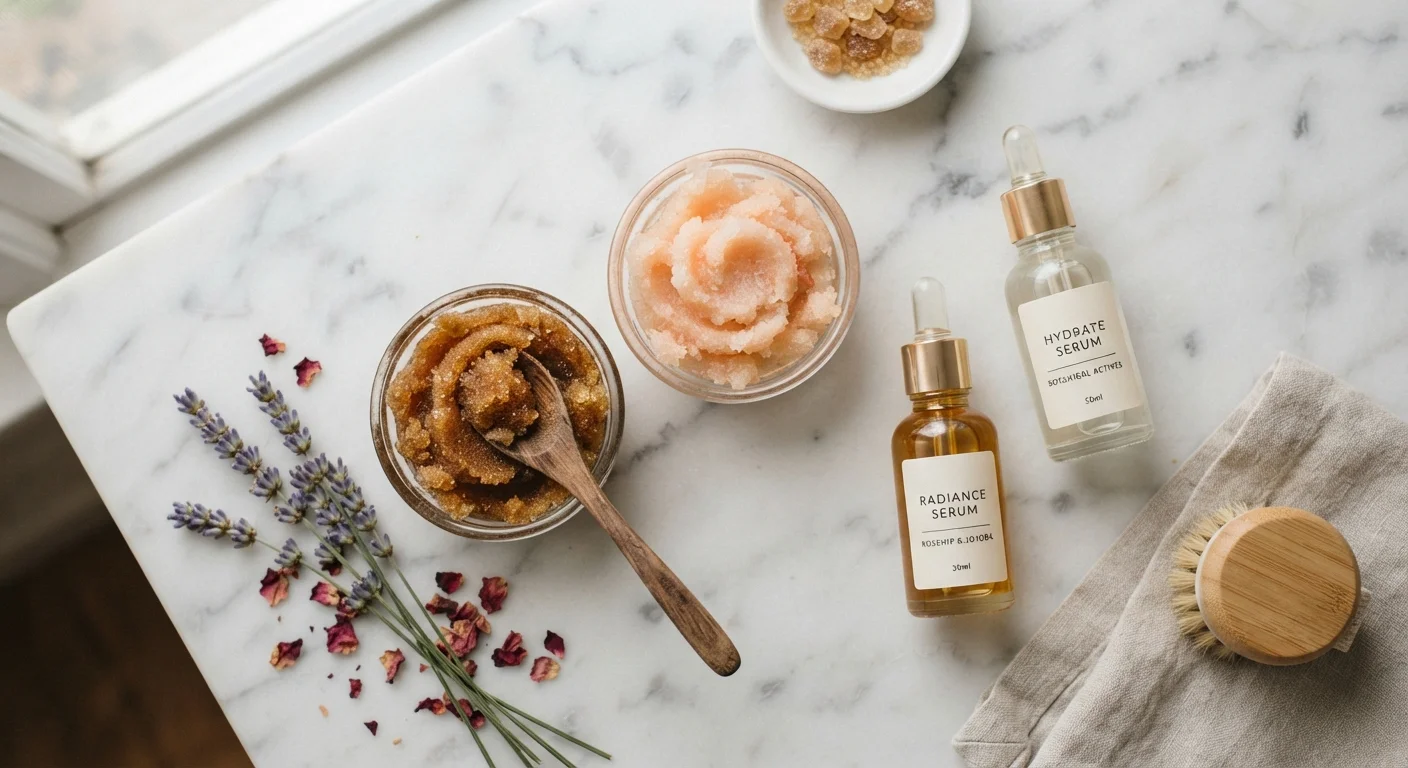
Physical scrubs work through mechanical friction. Granular particles — sugar, salt, rice bran, oatmeal, or synthetic microbeads — physically abrade and dislodge dead skin cells when you rub the formula across your face. The result is immediately tactile: skin feels smoother right away. However, that instant sensation can be deceptive; aggressive rubbing can create micro-tears in the skin's surface, particularly with harshly shaped particles.
To understand where exfoliation fits in your broader routine, see The Everyday Skincare Routine, Step by Step.
Head-to-Head: Chemical vs. Physical
The comparison below covers the key practical differences between the two approaches. Note that results always depend on the specific formula and how consistently — and carefully — you use it.
| Criterion | Chemical Exfoliants | Physical Scrubs |
|---|---|---|
| How it works | Dissolves cell bonds via acids or enzymes | Manually buffs cells away with particles |
| Depth of action | Surface to within pores (depending on type) | Surface level only |
| Results timing | Gradual improvement over days/weeks | Immediate smoother feel |
| Suitable for sensitive skin | Often yes, with low-strength formulas | Riskier; friction can cause irritation |
| Pore congestion | BHAs specifically target inside pores | Limited; works at skin surface only |
| Ease of control | Concentration and pH are measurable | Pressure-dependent; harder to standardize |
| Sun sensitivity risk | Yes — daily SPF recommended with AHAs | Minimal direct photosensitization |
| Best skin types | Most types; especially oily, acne-prone, dull | Resilient, non-reactive skin |
One distinction worth emphasizing: chemical exfoliants can be precisely formulated to specific pH levels and concentrations, giving formulators (and informed consumers) more control over the intensity of exfoliation. Physical scrubs are harder to standardize — the pressure of your hand and the texture of the particles both vary, making irritation easier to trigger accidentally.
If you're curious about how to decode the ingredient list on any exfoliant you're considering, Reading a Skincare Label Without a Chemistry Degree is a helpful starting point.
Who Should Use What — and When to Be Cautious
Neither method works the same way on every skin type, and the right choice depends on your skin's current condition, not just its general category. For a fuller picture of what your skin type actually means for your routine, see Skin Types Explained.
A Note on Combining Both Methods
Some people use both chemical and physical exfoliation — just not at the same time. Using a physical scrub and a chemical exfoliant on the same day (or in the same session) significantly increases the risk of irritation and barrier disruption. If you want to use both in your routine, alternating days or reserving each for different contexts (e.g., a gentle scrub in the morning, a chemical exfoliant in the evening on a different day) is a more measured approach. When in doubt, less is more.
Frequency matters as much as choice of type. Over-exfoliating — regardless of method — can disrupt the skin barrier, leading to tightness, redness, flaking, or increased sensitivity. Most dermatologists suggest starting with once or twice a week for any exfoliant and adjusting based on how your skin responds.
If your skin has recently felt dry, tight, or suddenly reactive after a period of working well, over-exfoliation may be a contributing factor. Why Your Skincare Stopped Working explores this pattern and how to troubleshoot it.
A few additional cautions worth noting:
- Chemical exfoliants — particularly AHAs — can increase sun sensitivity. Daily SPF use is strongly recommended when incorporating them into your routine.
- Physical scrubs with large, jagged, or irregular particles (walnut shell is a commonly cited example) carry a higher risk of micro-abrasions than finely milled alternatives.
- Those who are pregnant, nursing, or managing a skin condition should consult a dermatologist before adding any new exfoliant to their routine.
~28 days
Natural skin cell turnover cycle
The skin naturally sheds and renews its outer layer approximately every four weeks, a process that can slow with age — which is one reason exfoliation is commonly recommended.
2–5%
Typical AHA concentration in OTC products
Over-the-counter chemical exfoliants generally contain AHA concentrations between 2–10%, with lower percentages recommended for beginners and those with sensitive skin.
Understanding how these products interact with everything else you apply is also key — see Skincare Layering: The Logic Behind Product Order for guidance on sequencing.
This article is for general informational purposes only and is not medical or dermatological advice. If you have a skin condition or concerns about a specific ingredient, consult a qualified dermatologist or healthcare professional.