

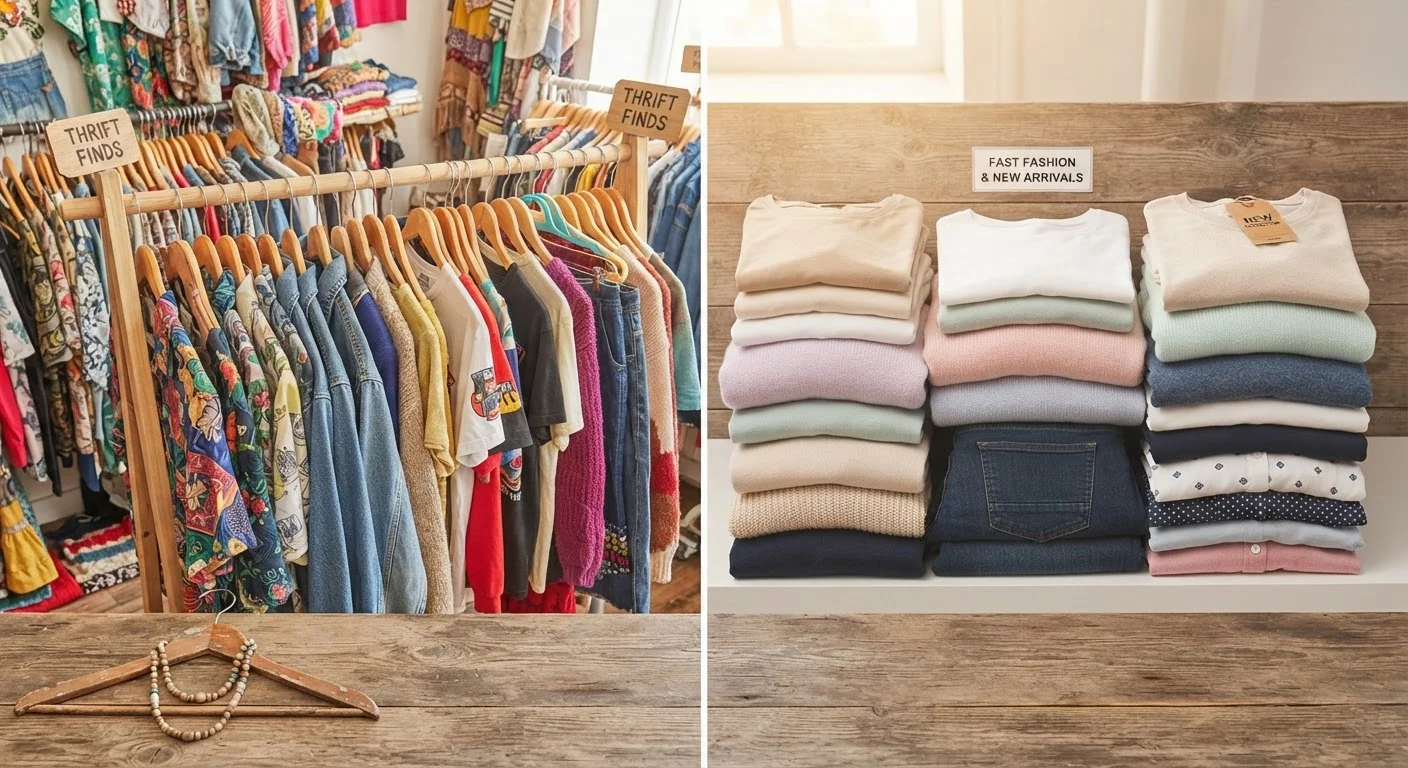
Key Takeaways
Option A
Thrift Store Shopping
The hunt-and-find approach to budget-conscious style.
Best for: Shoppers with flexible time, an eye for quality construction, and interest in one-of-a-kind pieces.
Option B
Fast Fashion
The quick, predictable route to trend-forward clothing.
Best for: Shoppers who need specific items quickly, value consistent sizing, and are working within a tight schedule.
If you have limited time and need something specific fast
Fast Fashion
Fast fashion retailers stock predictable styles in standard sizing, making it easy to find what you need without a lengthy search.
If keeping your clothing budget as low as possible is the priority
Thrift Store Shopping
Per-item prices at thrift stores are typically lower, and you can find durable, well-made garments for a fraction of their original cost.
If you want to reduce textile waste without abandoning affordable fashion
Thrift Store Shopping
Buying secondhand extends the life of existing garments, reducing demand for newly manufactured clothing.
If you need consistent sizing across multiple items for a uniform look
Fast Fashion
Standardized sizing and coordinated collections make it easier to assemble matching or cohesive outfits in one shopping trip.
If you enjoy exploring personal style without committing to a large spend
Thrift Store Shopping
Low per-item prices make it lower-risk to experiment with silhouettes, colors, and eras you wouldn't otherwise try.
Cost: What You Actually Pay Per Item
On raw sticker price, thrift stores usually win. A blazer that retailed for $80 might appear on a secondhand rack for $6–$15. For shoppers stretching every dollar, that gap is meaningful — and it's a core reason secondhand shopping fits naturally into the kind of thinking explored in our honest look at strict budgeting.
Fast fashion, by contrast, competes on a different kind of affordability: predictable, low prices on new items. A basic T-shirt or pair of jeans can cost $10–$25, and you know exactly what you're getting. There's no hunting involved. For families outfitting kids who grow quickly, or workers who need several uniform-adjacent pieces fast, that reliability has real value.
The hidden cost for thrift shoppers is time. Finding a specific item — the right size, condition, and style — can take multiple visits across several weeks. That time isn't free, and it matters more to some households than others.
| Criterion | Thrift Store Shopping | Fast Fashion |
|---|---|---|
| Average item cost | Very low; varies by store | Low to moderate; consistent |
| Time investment | High — browsing required | Low — targeted shopping |
| Size consistency | Inconsistent across eras | Standardized by retailer |
| Fabric and build quality | Variable; often older quality | Often lightweight or synthetic |
| Selection predictability | Unpredictable; hunt-based | Predictable; trend-driven |
| Environmental impact | Generally lower demand pressure | Higher production footprint |
| Availability for extended sizes | Often limited secondhand | More retailers carry extended sizes |
Quality and Longevity: Reading Between the Seams
Fast fashion's defining tension is price versus construction. Lower price points often mean synthetic blends, lighter-weight fabrics, and stitching that may not survive heavy washing cycles. As our guide on garment construction and quality signals explains, price alone is a poor proxy for durability — but fast fashion's business model does tend to favor speed over longevity.
Thrift stores, paradoxically, can surface genuinely well-made older garments. A wool coat or cotton Oxford shirt manufactured before the current fast fashion era may outlast nearly anything on a fast fashion rack today. The catch: condition varies wildly. Fading, pilling, missing buttons, and unpleasant odors are real risks. Inspection skills matter — check seams, zippers, and fabric weight before buying.
If you want to understand how fabric choice affects a garment's lifespan, it helps to know the basics of natural vs. synthetic fabric differences before you shop either venue.
~57%
Share of discarded clothing ending in landfills
According to the U.S. Environmental Protection Agency, textiles represent a significant and growing share of municipal solid waste.
2–3x
Longer average garment lifespan when worn regularly
Research from the Ellen MacArthur Foundation suggests garments worn more frequently per year have a substantially lower per-wear environmental cost.
~$1,700
Average annual U.S. household clothing spend
The U.S. Bureau of Labor Statistics Consumer Expenditure Survey consistently places household apparel spending in this range.
Convenience, Selection, and Fit
Fast fashion's clearest advantage is convenience. Inventory is organized by category, sizes are labeled consistently, and new stock arrives on predictable schedules. Shopping online extends that ease further — filtered searches, size guides, and easy returns reduce friction significantly.
Thrift stores offer a different kind of selection: unexpected variety across decades and styles. That's exciting if you enjoy the process. It's frustrating if you need a specific item by Thursday. Plus-size and petite shoppers often find secondhand inventory thinner in their size ranges, a genuine limitation worth acknowledging honestly.
Mixing both approaches tends to work well in practice. Thrift stores shine for outerwear, denim, and statement pieces where a great find at a low price is worth the search. Fast fashion fills gaps for basics, activewear, or time-sensitive needs. For strategies on working with what you already own before buying anything new, our piece on seasonal wardrobe transitions is worth a read.
A Note on Fit and Alterations
Thrift store garments are often priced low enough that minor tailoring — hemming pants, taking in a waist — is still cost-effective. A basic tailor visit typically runs $10–$30 for simple alterations, which can make a well-constructed secondhand piece fit far better than a new fast fashion item at a similar total price. Factor potential alteration costs into your comparison before dismissing a thrift find over a small fit issue.
Environmental and Ethical Considerations
The environmental conversation around both options is more nuanced than headline claims suggest. Thrift shopping extends the useful life of existing garments and reduces landfill volume — but thrift stores also discard a significant portion of donations, and transportation emissions from donation chains add up.
Fast fashion's environmental footprint is well-documented: water use, chemical dyes, synthetic microfiber shedding, and high return rates contribute to measurable waste. That said, buying fewer, more durable fast fashion pieces is less impactful than buying many cheap items repeatedly.
Neither option is a simple moral choice. The most durable wardrobe decision — secondhand or new — is often the one that results in you actually wearing items frequently and for a long time. Readers building a more intentional closet may also find our guide to the real pros and cons of a minimalist wardrobe useful for thinking through what you truly need.