

Key Takeaways
Hair Typing
Hair typing is the practice of identifying your hair's key physical characteristics — including curl pattern, strand thickness, and porosity — to better understand what care and products it responds to. No single number or letter captures everything about your hair; a complete picture uses all three dimensions together. Knowing your hair type takes the guesswork out of building a routine that actually works for you.
Porosity refers to the hair cuticle's ability to absorb and retain moisture, governed largely by the angle and condition of the cuticle layer. It is independent of curl pattern and can vary along the length of a single strand.
The Three Pillars of Hair Type
Walk into any beauty supply store and you'll encounter shelves organized by curl pattern — but curl pattern alone doesn't determine what your hair truly needs. Three distinct characteristics work together to shape your hair's behavior: porosity, curl pattern, and strand thickness. Understanding each one individually — and how they interact — is far more useful than chasing a single letter-number label.
Just as skin care looks different depending on whether you have dry, oily, or combination skin (see our guide to skin types for a helpful comparison), hair care should be anchored in your hair's actual characteristics rather than trend-driven advice.
~100,000
Average strands on a human scalp
Dermatologists generally cite approximately 100,000 hair follicles on the average adult scalp, though this varies by individual and hair color.
3
Core traits that define hair behavior
Porosity, curl pattern, and strand thickness each independently affect how hair responds to moisture, styling, and products — all three matter.
Porosity: The Moisture Gateway
Porosity refers to how readily the outer cuticle layer of your hair absorbs and retains moisture. Picture the cuticle as overlapping roof shingles: when they lie flat and tight, moisture has a harder time getting in — but also a harder time escaping. When the shingles are raised or damaged, moisture flows in easily and flows out just as fast.
- Low porosity: The cuticle lies flat. Water beads on the surface, products tend to sit on top rather than absorb, and heat (like a warm steam treatment) helps open the cuticle temporarily. Lightweight, water-based moisturizers tend to work well here.
- Medium (normal) porosity: The cuticle allows moisture in and out at a balanced rate. This is generally the easiest porosity level to maintain and responds well to most product types.
- High porosity: The cuticle is more open — often due to chemical processing, heat styling, or genetics. Hair absorbs moisture quickly but loses it rapidly too. Heavier creams, sealants, and layering methods (like the LOC method — liquid, oil, cream) help lock moisture in.
You can get a rough sense of your porosity with a simple float test: place a clean, shed strand in room-temperature water and observe whether it sinks quickly (likely high porosity) or floats for several minutes (likely low porosity). Treat this as a ballpark indicator rather than a definitive result.
Assess Hair in Multiple Sections
Don't rely on testing just one part of your head. Take note of strands from your crown, nape, and edges separately — porosity and curl pattern can differ meaningfully across those zones. A fuller picture leads to smarter product and technique choices.
Curl Pattern: Shape, Not the Whole Story
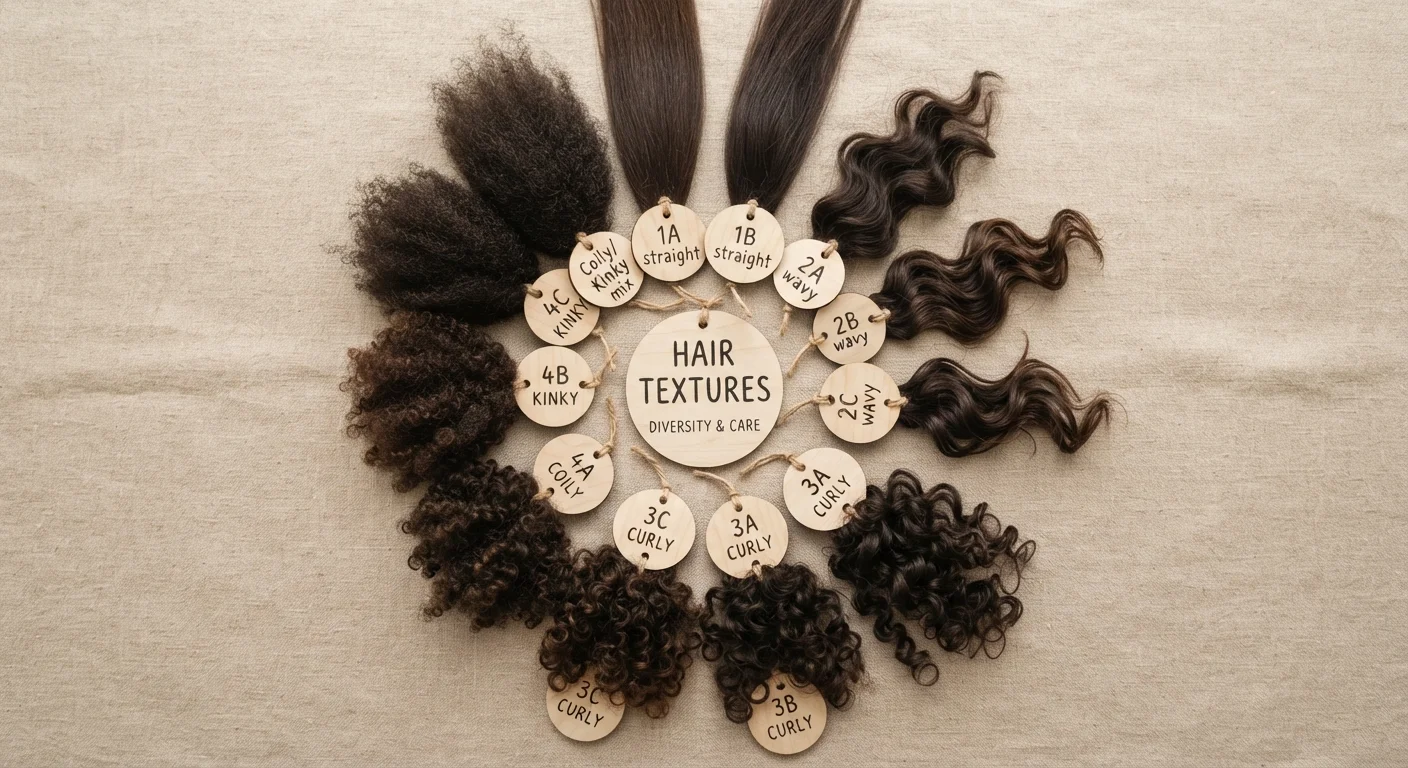
Curl pattern describes the shape your hair naturally forms — ranging from straight to wavy, curly, and tightly coiled. Many stylists and enthusiasts use a numbered system (broadly, Types 1 through 4 with lettered subcategories) as a common reference point, though no system fully captures every texture across the diverse range of human hair.
Curl pattern matters because it affects how sebum — the natural oil produced by the scalp — travels down the hair shaft. Straight strands allow oil to coat the length fairly easily; tighter coils make that journey more difficult, which is one reason coily and kinky hair textures tend toward dryness and benefit from added moisture more frequently.
It's worth noting that many people have multiple curl patterns on a single head. Your crown may behave differently from your nape, and edges often have their own texture entirely. Caring for your hair as a whole means identifying the dominant patterns and adjusting your approach section by section when needed. For a deeper look at routines built around coils and kinks, our natural hair care guide walks through everything from detangling to moisture retention.
Strand Thickness: Fine, Medium, or Coarse
Strand thickness — sometimes called strand width or texture — describes the actual diameter of an individual hair strand, independent of how many strands you have on your head (that's density, a related but separate characteristic).
- Fine strands
- Each individual strand is narrow. Fine hair can be more susceptible to breakage, tends to get weighed down by heavy products, and may feel limp when over-moisturized or over-conditioned with protein.
- Medium strands
- The most common thickness. Medium hair is generally resilient and tolerates a wide range of products and styling methods without much drama.
- Coarse strands
- Each strand has a larger diameter and a denser cuticle layer. Coarse hair tends to be stronger, can handle heavier products, and typically needs more moisture to stay flexible and manageable.
A quick way to estimate thickness: hold a single shed strand up to the light. If it's barely visible, it's likely fine; if it's clearly present and feels somewhat substantial between your fingertips, it's likely medium to coarse. These are rough guides — a professional stylist can offer a more precise assessment during a consultation.
Many persistent beliefs about strand thickness and what it can or can't do turn out to be oversimplified. Our hair myths breakdown separates fact from fiction on some of the most common claims.
Density vs. Thickness: Not the Same
Strand thickness describes the diameter of each individual hair. Density refers to how many strands you have per square inch on your scalp. You can have fine strands and high density (a full-looking head with delicate individual hairs) or coarse strands and low density. Both characteristics influence how your hair looks and how products behave, so it helps to identify each separately.
Putting It All Together
The real value of understanding these three characteristics comes when you combine them. Someone with fine strands, low porosity, and a wavy curl pattern has very different needs than someone with coarse strands, high porosity, and tightly coiled hair — even if both feel like their hair is "dry."
Once you have a working sense of your porosity, curl pattern, and strand thickness, you can evaluate products and techniques based on their ingredients and weight rather than marketing claims. For example, if you have fine, low-porosity hair, you'll likely want to avoid heavy butters that sit on the surface; if you have coarse, high-porosity coils, those same butters may be exactly what helps seal in moisture.
Protective styling is one practical area where knowing your hair type pays off directly — certain styles that work beautifully for medium-density, coarse hair may cause tension and breakage on fine strands. Our guide to protective hairstyles covers how to assess whether a style is right for your specific hair. Start with honest observation, adjust based on how your hair responds, and remember that your hair's needs can evolve over time.
“The most important thing you can do for your hair is learn to observe it — how it behaves when wet, how it dries, how it responds to products. That information is more valuable than any label or system.”
— Curl texture educator and licensed cosmetologist, Licensed cosmetologist and natural hair educator