

Key Takeaways
Lighting Layers
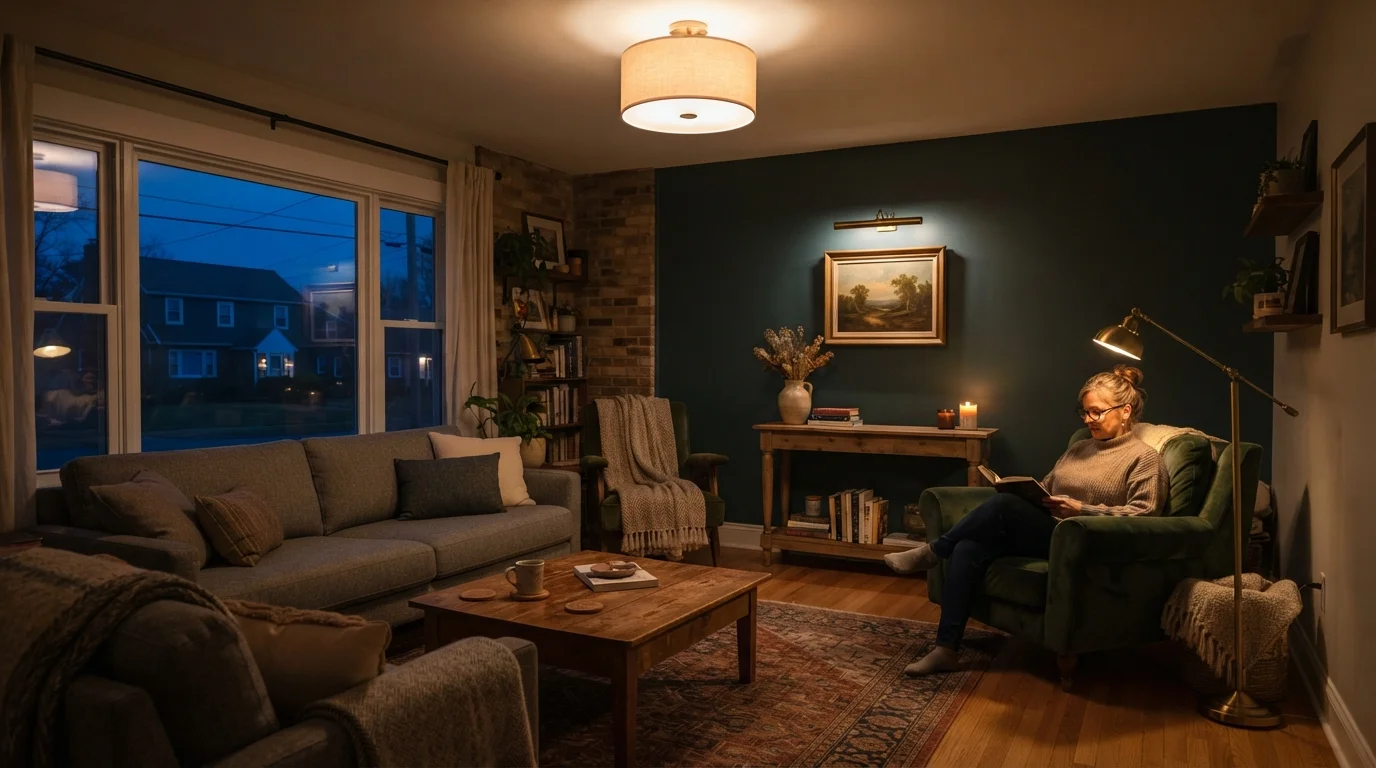
Lighting layers refer to the practice of combining three distinct types of light - ambient, task, and accent - within a single room. Rather than relying on one overhead fixture to do everything, layered lighting addresses different needs at the same time: general visibility, focused work light, and decorative atmosphere. The result is a room that feels both functional and visually interesting at any time of day.
Each layer typically operates on separate switches or dimmers, giving occupants independent control over the room's mood and function without rewiring the entire space.
Why One Overhead Light Is Never Enough
Almost every room starts its life with a single ceiling fixture wired in by a builder. It works - technically - but it rarely makes a room feel good. Overhead light from one source casts flat, even illumination that eliminates the depth and shadow that make a space feel warm and three-dimensional. It also fails at specific tasks: it's too dim to read by comfortably, too harsh for a relaxed evening, and too generic to highlight anything you actually care about.
Professional lighting designers address this by thinking in three distinct layers: ambient, task, and accent. Each layer serves a different purpose, and together they give a room the flexibility to support any activity and mood. Understanding what each layer does - and where it goes - is the foundation of a well-lit home.
This same principle connects to broader interior design thinking. As we explore in The Principles of Interior Design Every Home Decorator Should Understand, emphasis and contrast are core design tools - and lighting is one of the most powerful ways to create both.
Ambient Light: The Foundation Layer
Ambient lighting is the room's general illumination - the background light that allows you to navigate safely and see everything at a basic level. Think of it as the equivalent of natural daylight: it fills the room without directing your eye anywhere specific.
Common sources of ambient light include ceiling fixtures, recessed can lights, flush-mount pendants, and chandeliers. In rooms with high ceilings, uplighting - fixtures that bounce light off the ceiling - can create a softer, more diffuse glow than downlights aimed directly at the floor.
The goal with ambient lighting is not maximum brightness. It should be comfortable as a baseline, easily dimmed for evenings, and bright enough for routine activities like tidying or entertaining. A dimmer switch makes this layer dramatically more versatile.
Start Every Room with a Dimmer
Before adding more fixtures, install a dimmer on your existing ambient light source. This single change gives your room more tonal range than switching from one bright ceiling light to another. Most standard dimmers are compatible with LED bulbs, but check the dimmer's compatibility list before purchasing.
Task Lighting: Functional and Focused
Task lighting goes exactly where you need to see clearly. It supplements ambient light in areas where close-up, detail-oriented work happens - reading, cooking, applying makeup, working at a desk, or following a recipe at a kitchen counter.
What separates good task lighting from just pointing a lamp at something is directionality. The light should be aimed at the work surface, not at your eyes. Poorly positioned task lights create glare and cause eye fatigue faster than no task light at all.
Typical task lighting sources include under-cabinet kitchen lights, adjustable desk lamps, swing-arm reading lamps beside a chair or bed, and pendant lights hung low over an island or dining table. In bathrooms, vanity lighting positioned at the sides of a mirror (rather than above it) dramatically reduces shadows on the face.
~30%
Energy savings from task lighting vs. overhead-only
Using focused task lights instead of raising overall ambient brightness can meaningfully reduce energy use, according to general efficiency guidance from the U.S. Department of Energy.
3×
Brightness ratio: accent to ambient
Interior lighting guides commonly recommend accent lights be approximately three times the intensity of the surrounding ambient level to create effective visual contrast.
When decorating compact spaces, task lighting does double duty - it adds functional illumination while contributing visual interest. Our guide to decorating a small living room without making it feel cramped explores how the right lamp placement can make a tight room feel more intentional and spacious.
Accent Lighting: Depth, Drama, and Detail
Accent lighting is the layer most often skipped - and the one that makes the biggest visual difference when it's finally added. Its job is to draw the eye to something specific: a piece of art, a bookshelf, an architectural detail like exposed brick, a collection on a console table, or plants in a corner.
The general rule of thumb is that accent lights should be roughly three times brighter than the ambient level in the area they're illuminating. This contrast is what creates depth and makes the highlighted object actually stand out rather than just getting slightly more light than everything else.
Sources include picture lights mounted on frames, track lighting aimed at a wall, directional recessed fixtures, LED tape lights tucked inside shelving, and small spotlights at floor level aimed upward at plants or textured walls.
“Light is the first element of design; without it there is no color, form, or texture.”
— Le Corbusier, Pioneering modernist architect and designer
Accent lighting also interacts directly with your wall finishes. A raking light - positioned close to and almost parallel to a textured wall - will dramatize the surface dramatically. As we note in Paint Finish Types and Where Each One Actually Belongs, a satin or semi-gloss finish will reflect accent light differently than a flat matte surface, which is worth factoring in during planning.
Combining All Three Layers Effectively
The real benefit of layered lighting comes from the ability to mix and adjust each layer independently. A living room at 7 p.m. might call for soft ambient light, a bright task lamp beside the sofa for reading, and a gentle accent light on the bookcase. At 10 p.m., you might dim everything down and turn off the task lamp entirely. This flexibility is only possible when each layer is on its own switch or dimmer.
When planning your layers, start with ambient and work outward. Identify the room's primary function and its secondary uses, then map which areas need task lighting and which features - if any - are worth accenting. You don't need to add every layer all at once. A plug-in floor lamp repositioned as an accent or a simple desk lamp added to a dim corner can make an immediate difference without any construction.
Good furniture arrangement supports lighting decisions, too. Furniture arrangement fundamentals and lighting placement work together: where you put a reading chair determines where the task lamp needs to go, and the focal point of the room determines where accent lighting will have the most impact.
Color also interacts directly with light levels and temperature. If you're navigating color decisions alongside lighting choices, Decorating with Color When You're Not Sure Where to Start explains how warm and cool tones respond differently depending on the light source illuminating them.
Electrical Work Requires a Licensed Electrician
Adding new hardwired fixtures, installing dimmer switches in older homes, or running new circuits should be handled by a licensed electrician. Plug-in solutions - floor lamps, table lamps, LED strip lights - let you experiment with layering safely without any electrical modifications. Always verify local permit requirements before beginning any wiring work.